The memorial event last night for Alex Doty
was unlike anything I've ever attended at SCMS (or any other conference for
that matter). Lovingly arranged and choreographed by this year's Queer Caucus
officers (Jen Malkowski,
Patty Ahn and Julia Himberg) and
as equally lovingly attended by a great many friends, colleagues, and fans of
Doty, the affair was at once a vibrant, communal celebration of a particular man
and scholar as well as serving as a reminder of the role of intellectual
community, in this case the SCMS Queer Caucus (of which Doty was a founding
member). Let me start with the man, and end with the caucus, a provocation (or
two), and an invitation.
There were six beautiful, careful
presentations from the stage and a cocktail party after. In the first version
of this post that just got eaten by my computer, I carefully detailed each
one’s loving remarks and how they built the presence of a respected, treasured,
seminal member of the SCMS community. From SCMS President, Chris Holmlund’s detailed tracing of
the history of the Queer Caucus itself, exactingly drawn through a treasure
trove of documents from the Society’s past (located by Michael Metzger), to
Corey Creekmur’s evocation of Doty as "not a person but an event,” to Kara
Keeling’s anecdote about reading Making
Things Perfectly Queer as a grad student and learning there the "things I already knew
but did not know why I knew these things,” or Taylor Cole Miller explaining how
his teaching always accounts for a queering of popular culture, for all
students and across creative exercises because of an approach he learned from
Doty’s writing, or Sarah Sinwell’s reminder that so many in the room had used
Doty’s quote about a "queer reading” not being "alternative, or wishful
thinking, or reading into things too much.” The take away was both a brave,
fun, dedicated intellectual, teacher and friend who had the courage to work
with others to found a sub-field based upon how he lived in the world, and in
the world of media, and also a tender community of people who know each other
in a variety of ways: from conferences, caucuses, and lectures, to the many words
we write and share over a career.
And
listening to the care by which these colleagues drew this man and his work, and
seeing the care by which the organizers had produced the event, I saw that part
of what the Queer Caucus (and Alex Doty, and so many more of us) have produced
is the place for love, or respect, and the personal, within professional
contexts: and this has always been at the heart of our theoretical and
political project as feminists (and I’d warrant many of the other Caucuses
share this project). The Alexander Doty Queer Mentoring Program of the Caucus
is one example of this practice, as is Doty’s writing and teaching. And yet, as
scholars, we so rarely publicly express the fondness, and other feelings, we
have for our colleagues: how their work moves us. I thought to myself, I bet
Alex didn’t know this—that we all
knew him in one way or another, and respected him, and understood (or wanted to
understand) his part in our own history as intellectuals and activists—because
we so rarely tell each other: I used
you in a paper, or I taught you in a class, or your words saved me.
And then,
I wondered, too, about those who didn’t
know Alex, who weren’t at the memorial, and weren’t members of our Caucus, and
didn’t read his books or attend his lectures … even once. Man did you miss
something and someone! Sean Griffin said of Alex how he always managed to fashion both
camaraderie and a diva moment, producing an "I’m fabulous and you are all going
to come with me” sort of presence wherever he was at work. But if you didn’t
track through SCMS seeing the faces I have come to know, again and again, given,
as you might not be—queer—maybe you didn’t know this ... So, I thought of the others
Caucuses, and wondered if love and anger and pride was in their hearts and
history, and if they might have an event like this someday, as sad as that may
be.
And that
leads me to my provocation, and my title, which points to the centers of
centers and the margins of margins in the making of fields and communities, and
sub-fields and their communities. Are we queers central to this field? Do you
know us and our work? Do I know your work and caucus? Let’s try to go to another
sub-field’s meeting or panel at this conference, and meet the Alex Doty we
wouldn’t necessarily circulate around by way of affinity. And what's more, let’s tell a
colleague or friend that their ideas move us, so that we can mark our love for what Griffin
called "the concept” (our work) as well as the person, and so that the person
can know we cherish their concepts while we are together still.
And finally,
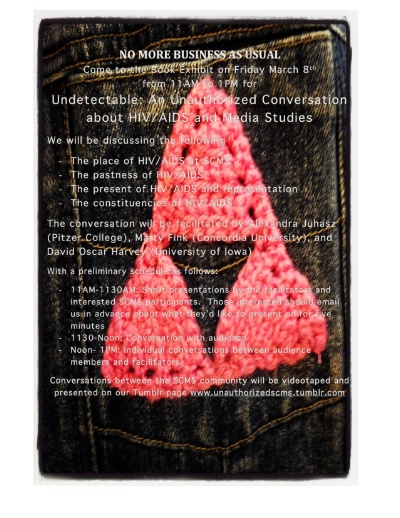
an invitation in kind: tomorrow, Friday, March 8, I will be participating in an "Unauthorized
Conversation” about HIV/AIDS and Media Studies, in the Book Exhibit from 11-1. With
my friends, colleagues, and AIDS comrades in arms, Marty Fink and David Oscar Harvey, we will engage in a
conversation about many queer things, including some of the questions I asked
above: about the history and politics of sub-field production and maintenance
given the growth of the larger field. You don’t have to be queer to know about
AIDS, or to care about its place in Media Studies. We’d love to have you as part of the conversation.

 Group Home
 Blog Home
 Group Blogs
 RSS