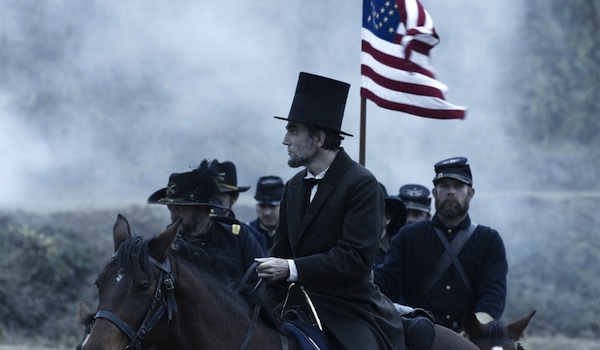
Lincoln is not a movie about Reconstruction, of course;
it’s a movie about old white men in beards and wigs heroically working
together to save grateful black people.
Steven Spielberg and Tony Kushner’s Lincoln is about Obama,
we are told, or don’t need to be told. It is about the triumph of a
political compromiser, and it argues that radical change comes about by
triangulation, by back-room deals, and by a willingness to forego
ideological purity. Kushner has said
this quite explicitly, not only likening his Lincoln to Obama, but
arguing that there are general principles to be drawn from it; "too much
impatience can make it impossible for anything to happen,” he said, in
response to Chris Hayes’ question about whether the movie favors
moderates over radicals. It is, in short, a barely veiled argument that
radicals should get in line, be patient, be realistic.
It does this in several ways. First and foremost, it uses a realist aesthetic to make it seem like a compromising cynicism is realistic.
Form becomes content: it shows us the world as it "really” is by adding
in the grit and grain and grime that demonstrate that the image has not
being airbrushed, cleaned up, or glossed over, and this artificial lack
of artifice signifies as reality. This is why people who know nothing
about Baltimore or the drug trade are quick and confident in praising
the "realism” of a show like The Wire. They don’t mean
"accuracy,” because that’s not something most people could judge; they
mean un-glamorized, un-romanticized, dark. Spielberg’s Lincoln accomplishes
the same trick, making its claim to "realism” seem plausible by showing
us a Washington, DC that is dirty, small, dark, cold, unpleasant, and
corrupt. Our field of view is claustrophobic and drab; we are shown a
political arena without sentiment or nostalgic glow. That’s how we know
we’re seeing the "real” thing.
But, of course, we’re not. We’re just seeing a movie whose claim to
objective accuracy is no less artificial than the filters by which an
instagram takes on the nostalgic glow of a past that was never as
overexposed and warm as it has become in retrospect. And when we take
"gritty” for "realism,” another kind of "realism” gets quietly implied
and imposed: the capitalist realism
by which ideals become impossible and the only way things can get done
is through compromise and strategic surrender. Anti-romanticism is all
the more ideological because it pretends to have no ideology, to be the
"plain truth” that demonstrates the falsity of romantic visions. And
this movie is anti-romantic because, to be blunt, it is
anti-revolutionary. In this movie, "things happen” through patience and
compromise, not through steadfast idealistic struggle.
When Lincoln sets about abolishing slavery–out of the goodness of his
heart, essentially–his first adversaries turn out to be the radical
abolitionists, in whose number the movie is careful not to place the
great emancipator. Before anything can happen, in other words, the first
order of business is to steamroll men of principle like Thaddeus
Stevens and James Ashley into doing what Lincoln wants them to do.
Stevens is too wildly idealistic and unrealistic to be allowed to speak
his mind; he isn’t quite a caricature—if only because Tommie Lee Jones
brings too much gravitas to the part—but he’s the uncle everyone is
embarrassed of, even if they love him too much to say so. He’s not a
leader, he’s a liability, one whose shining heroic moment will be when
he keeps silent about what he really believes. And James Ashley is
portrayed as too cowardly and weak to even bring the amendment to a vote
(while casting David Costabile for the part speaks volumes for what
kind of a role they think it is). The two radical abolitionists in the
film, in other words, cannot be trusted to take charge of a radical
project like the abolition of slaves. A radical and revolutionary change
must be placed in the hands of a compromising moderate.
Now, I’m not questioning this movie on the grounds of historical
accuracy, because if you wanted historical accuracy, you wouldn’t see
this movie at all. You might go read Doris Kearns Goodwin’s Team of Rivals,
for example, and then you might notice that the entire story that
Kushner and Spielberg tell is contained in pages 686-689, a sum total of
three pages out of a 900 page book about Lincoln’s presidency. Or you
might read a book on Reconstruction—Eric Foner’s long book or his short book,
for example—and discover that the Thirteenth Amendment was not the
culmination but was barely the prologue to a political struggle that
went on for many decades. Or read Freedom: A Documentary History of Emancipation, 1861-1867, which shows how (as Corey Robin puts it), "students and scholars have come to a completely different view of how emancipation happened”:
The Destruction of Slavery [the first
essay in the book] explicates the process by which slavery collapsed
under the pressure of federal arms and the slaves’ determination to
place their own liberty on the wartime agenda. In documenting the
transformation of a war for the Union into a war against slavery, it
shifts the focus from the halls of power in Washington and Richmond to
the plantations, farms, and battlefields of the South and demonstrates
how slaves accomplished their own liberation and shaped the destiny of a
nation…
Emphasizing the agency of slaves and former slaves does not simply
alter the cast of characters in the drama of emancipation, displacing
old villains and enthroning new heroes. Abraham Lincoln and the Radical
Republicans do not play less significant parts once slaves gain an
active role in their own liberation, but they do play different ones.
Focusing on events beyond Washington and outside formally constituted
political bodies does not excise politics from the study of the past.
Rather, it reveals that social history is not history with the politics
left out, but that all history is—and must be—political. The politics of
emancipation in the countryside and the towns of the South makes more
comprehensible the politics of emancipation inside the capitol and the
presidential mansion.
Kate Masur’s NYT op-ed
on the movie makes this same point, that what was going on outside of
the smoky back rooms and kitchen conversations (and away from the
battlefields) was the driving force for the social transformation which
was already occurring but which would continue for decades.
In short, if you widen your field of view, you will discover that W.E.B. Du Bois argued a century ago—and as the historical scholarship has increasingly come to agree—that
slavery was already all but dead by the time Lincoln got around to
declaring himself an abolitionist, far less because the North gave
slaves their legal freedom than because they had already effectively
taken it, because it had become the new status quo that would have
required force to dislodge. At the end of the Civil War, with the South
defeated, the choice for the north was not to end slavery or leave it;
the choice was to ratify the fact that it was already dead or to
re-impose it by military force.
In short, the idea that the white north "gave” freedom to the slaves
draws from and reinforces an attractively simple and flattering myth,
one which formed around the old historiography of the period like a
noose cutting off oxygen to the brain: the myth that black slaves were
rendered passive by their condition, and that—absent an outside force
interrupting their state of un-freedom—they would simply have continued,
as slaves, indefinitely. It’s only in this narrative that freedom can
be a thing which is given to them: because they are essentially
passive and inert, they require someone else—say, a great
emancipator—to step in and raise them up.
W.E.B. Du Bois was already chipping away at this myth in 1909, but when scholars in the post-Civil Rights era started taking him and his 1935 Black Reconstruction seriously, the historiographic mainstream turned this myth on its head. Slaves were not and could not be "given” their freedom because they had always had it: it had required a great deal of violent force and political work to keep
them enslaved, and when that force was removed—as the South collapsed
politically and militarily—they began to act like the human beings they
always already were, organizing, moving, and seizing their destinies in
their own hands. At this point, the game was up; just as the institution
of slavery had always depended on substantial governmental enforcement
and support, it would have taken a substantial amount of violent force
to re-impose it, a concerted project to re-establish slavery that no one
in the north had any particular stomach for. At the end of the Civil
War, to put it simply, the North had a simple choice: re-imposing
slavery by force or accept the new reality. They chose the latter.
If you read these books, however, you’d gain a sense of perspective
that the film works to make impossible. Spielberg and Kushner are
interested in a kind of scrupulous (almost farcical) accuracy about things that do not matter,
while working very hard to place everything else that was going on in
the period—and everything else Lincoln was responding to—off camera.
"The nation’s capital was transformed by the migration of fugitive
slaves from the South during the war, but you’d never know it from this
film,” as Kate Masur points out,
and Lincoln’s own servants were leaders and organizers in this
community, something of which Lincoln simply could not have been
unaware. But the film makes a point of not showing any of this: while
the vast majority of the movie takes place in cramped and smoky rooms,
even the exterior shots (usually of conversations in moving wagons) show
us very little of what was going on in the streets and neighborhoods of
Washington (much less what was going on in the South). Which is to say:
they give us the illusion of perspective without giving us its
substance. They show you the elephant’s tail quite accurately, and then
they declare, on that basis, that the entire beast is a snake.
In the big picture, the Thirteenth Amendment, on its own, just isn’t
that important, and much of the forced suspense of the movie—will they
pass it?—comes from an artificial sense that more is at stake in a
single congressional bill than there actually was. As Eric Foner pointed out
when he was asked about the movie, if it hadn’t passed when it did,
Lincoln had pledged to call Congress into special session in March;
"[a]nd there, the Republicans had a two-thirds majority and would ratify
in a minute…It’s not this giant crisis in the way that the film’s
portraying it.” This is important because the small picture is not the
big picture in miniature, and taking it to be—taking the passage of the
Thirteenth Amendment to be 19th centuries democratic turning
point, as this movie clearly does—will cause us to subordinate the big
picture to the small picture. For Foner,
The emancipation of the slaves is a long, complicated,
historical process. It’s not the work of one man, no matter how great he
was…It was not Lincoln who originated the 13th Amendment, it was the
Abolitionist movement. It’s only in the middle of 1864 that Lincoln
changes his mind and decides he’s in favor of this amendment…It’s not a
question of being wrong, it’s just inadequate. It gives you the
impression that the ratification of the 13th Amendment ends slavery —
and that’s wrong. Slavery is already dying at that moment.
This big-picture perspective is carefully absent, displaced by an
obsessive focus on political minutia, a claustrophilic aesthetic, and
the usual hagiography of Lincoln. One can only imagine what a very
different movie this would be if it had taken Foner’s The Fiery Trial: Abraham Lincoln and American Slavery as its main source text. But while we can agree or disagree with that choice, the one thing we can’t
do is pretend that it wasn’t a choice. And to put it quite bluntly, I
think the filmmakers made this choice because they wanted to make a
polemical point about moderation over radicalism, and I think they
picked the story they wanted to tell because it seems to support that
position. And yet the historical story they tell only supports that
claim if you very selectively frame out most of the context around it,
and so they do. And passing a single bill in Congress only comes to seem
to represent the broader field of social change and progress—"things”
getting "done”— if we ignore the big picture.
After all, getting the radicals in line is important in the political
arena because it allows moderates like Lincoln or Obama to operate
through consensus. We therefore see Lincoln pragmatically compromising
with conservative republicans (giving them negotiations with the
confederacy) while ignoring and sidelining the left (because they have
no choice but to follow him). But that consensus is built on respect for
the status quo. And if true political change happens when a bunch of
old white men in beards make deals in smoke-filled back rooms, then we
can hardly be surprised that the black men and women will watch mutely
from the balcony. As in To Kill a Mockingbird, they will
applaud the hero in the foreground, a folksy white lawyer, but they will
not have a vote or voice of their own. Black "voices” will appear only
as tokenistic sops to political correctness, because we have
categorically ruled out the existence of black political action from the
start. And so, we will take for granted the question we have begged,
that politics only happens in the arena of politics, and since only
people who could vote (white people) could intervene in the latter, then
it seems reasonable to believe that black people had no effect on the
politics of slavery and emancipation (except insofar as they inspired
the people who mattered).
The trouble is, though, for me to make this point, one must call on
all the sources and accounts and stories that the movie has scrupulously
not included. If you’ve read Du Bois’s Black Reconstruction, for example, and you watch this movie and tell to people they should read Du Bois’s Black Reconstruction, you won’t win many arguments; until someone has read Du Bois’s Black Reconstruction (or some version of it), they will have literally no idea what they are missing.
So let me talk a bit about what the movie does show, instead
of focusing on what it doesn’t. The film’s treatment of Thaddeus
Stevens is perhaps the most revelatory, and the clearest demonstration
of how the movie disdains and diminishes the importance of principled
radicalism. The character that Tommie Lee Jones plays is a fire and
brimstone radical who wants to occupy the South militarily, who wants to
enforce black freedom at bayonet point, and who want to extract from
wealthy southerners some of the wealth they had extracted from their
slaves and set up freed slaves on their own farms. He would give them
the forty acres and a mule, in short, and if Lincoln is Obama, then
Stevens is a little bit like what the Tea Party thinks Obama to be: a
socialist bent on revenge and wild wealth redistribution.
When people on the right declare that Obama is an anti-colonial
socialist, leftists often sigh, wistfully; "If only!” This movie nods
its head soberly. "Yes,” it says, "Redistributing wealth to slaves from
their former owners sounds good in practice, but we need to be realistic;
it wouldn’t work in practice.” That’s why this movie needs to
domesticate Stevens, why things only "get done” when the impatient
Stevens is convinced to shut up and get in line, to stop demanding that
black people get the vote and accept that "giving” them freedom was
enough. Lincoln wins the argument with Stevens—in their dramatic kitchen
conference—when he points out that if Stevens had gotten his way, all
would have been lost. Stevens’ impatience would have doomed the war
effort, and on this basis, Stevens is won over to Lincoln’s cautious
quest for consensus.
After Lincoln was dead, however, progressive politics would be driven
by radicals and freedmen, and it was in this period that substantive
emancipation was first achieved. On the one hand, the period of Radical
Reconstruction—roughly 1867 to the early 1870’s—was called that because
congressional radicals like Thaddeus Stevens were actually in charge of
Reconstruction and did many of the things which the movie portrays as
being Stevens’ wild and impatient radicalism. But while military
governors (and Southern Unionists) helped the genie first get out of the
bottle, black organizations and practical politics were the genie’s
active demonstration that it had no plan to go back in without a fight,
nor did it. It would take decades of fierce political warfare, mass
racist violence, and a popular (white) backlash against radical
reconstruction before blacks would be put back in their place.
It was in this context that a new narrative of the Civil War and
reconstruction began to emerge and became mainstream, in which Lincoln
was the great reconciler and in which his death was a great tragedy because it left vindictive radicals like Stevens in charge. This is how The Birth of a Nation portrays the aftermath of the Civil War, for example:
Though a Southerner, Griffith (like Dixon)
admired Lincoln for his magnanimity and believed that if he had not been
murdered, Reconstruction generally (and the radical Reconstruction
after 1867 in particular) would not have happened. With the war over, Griffith depicts a confrontation between Lincoln and Austin Stoneman, the leader of the radicals. Stoneman protests Lincoln’s policy of clemency
for the South, insisting that "their leaders must be hanged and their
states treated as conquered provinces.” (The "conquered provinces”
phrase was actually used by Thaddeus Stevens, the radical congressional leader on whom Stoneman’s fictional character was based.) But Lincoln lives up to the spirit of his second inaugural on March 4, 1865 ("with malice
toward none; with charity for all”) and tells Stoneman he will deal
with the seceded states "as though they had never been away.” Encouraged
by this liberal attitude on the part of the president, the South begins rebuilding itself (shots 529–35), but this process is interrupted by Lincoln’s death.
Spielberg’s Lincoln is strikingly consistent with The Birth of a Nation’s
image of Lincoln, a fact which should sound as bizarre as it is. As
Eric Foner has observed, reconstruction was an "unfinished revolution”
precisely because people like Stevens didn’t get their way in
the long terms, because a revolution was eventually turned into
reconciliation between Northern and Southern Whites and African-American
freedom was abandoned.
In an interview on NPR, Tony Kushner suggests that vindictive radicals like Stevens bear some of the blame for this:
The inability to forgive and to reconcile with the South
in a really decent and humane way, without any question, was one of the
causes of the kind of resentment and perpetuation of alienation and
bitterness that led to the quote-unquote ‘noble cause,’ and the rise of
the Klan and Southern self-protection societies. The abuse of the South
after they were defeated was a catastrophe, and helped lead to just
unimaginable, untellable human suffering.
That’s one perspective, I suppose, the Dunning School of American historiography that Corey Robin recalls
being taught in 1985 as an example of how not to do history, "a way of
thinking about the past that was so benighted no one could possibly
believe it anymore.”
What a radical like Thaddeus Stevens believed was that the 13th
Amendment only opened the door, and that without federal support for
black suffrage, and without redistributive measures to establish black
economic security, few freed slaves would ever manage to walk through
it. I think the end of radical reconstruction, the long Jim Crow era,
and the Civil Rights movement more or less prove him right. As W.E.B. Du
Bois argued in 1901, readmitting the South to the Union without federal protections for the black vote was to abandon them to their fate:
[In 1866] Not a single Southern legislature stood ready
to admit a Negro, under any conditions, to the polls; not a single
Southern legislature believed free Negro labor was possible without a
system of restrictions that took all its freedom away; there was
scarcely a white man in the South who did not honestly regard
Emancipation as a crime, and its practical nullification as a duty. In
such a situation, the granting of the ballot to the black man was a
necessity, the very least a guilty nation could grant a wronged race,
and the only method of compelling the South to accept the results of the
war. Thus Negro suffrage ended a civil war by beginning a race feud.
This is why reconstruction was an "unfinished revolution” and why
freedom was an un-cashed check for generations. African-Americans were
given the right to be paid for their labor, but even the right not to be
murdered was a dead letter across much of the country: lacking economic
independence or protected political franchise, black Americans would
have no control over the conditions under which they labored and no say
in the civil society they would continue to define by being excluded
from it. As Du Bois went on, speaking in the present tense of 1901:
For
this much all men know: despite compromise, war, and struggle, the
Negro is not free. In the backwoods of the Gulf States, for miles and
miles, he may not leave the plantation of his birth; in well-nigh the
whole rural South the black farmers are peons, bound by law and custom
to an economic slavery, from which the only escape is death or the
penitentiary. In the most cultured sections and cities of the South the
Negroes are a segregated servile caste, with restricted rights and
privileges. Before the courts, both in law and custom, they stand on a
different and peculiar basis. Taxation without representation is the
rule of their political life. And the result of all this is, and in
nature must have been, lawlessness and crime. That is the large legacy
of the Freedmen’s Bureau, the work it did not do because it could not.
This was the victory of compromising moderates over radical
revolutionaries. Lincoln never had the opportunity to show us what he
would have done, but the verdict is certainly in on his successor,
Andrew Johnson (who Stevens impeached). And as Eric Foner has argued,
the failure of reconstruction wasn’t just a disaster for freed slaves:
by disenfranchising a sizable segment of the South’s workers, the
backlash against reconstruction helped produce the reactionary political
order under which we still labor:
The removal of a significant portion of the nation’s
laboring population from public life shifted the center of gravity of
American politics to the right, complicating the tasks of reformers for
generations to come. Long into the twentieth century, the South remained
a one-party region under the control of a reactionary ruling elite who
used the same violence and fraud that had helped defeat Reconstruction
to stifle internal dissent. An enduring consequence of Reconstruction’s
failure, the Solid South helped define the contours of American politics
and weaken the prospects not simply of change in racial matters but of
progressive legislation in many other realms.
Lincoln is not a movie about Reconstruction, of course; it’s
a movie about old white men in beards and wigs heroically working
together to save grateful black people. And that’s exactly the point:
this is not a movie about the long process of reuniting the country or
black freedom.
If Spielberg had made a movie about reconstruction, it would be
difficult to find many heroes, certainly not any who were compromising
moderates. Thaddeus Stevens would die not long after engineering the
impeachment of Andrew Johnson (for working against Radical
Reconstruction, essentially) and the story of black freedom after
Lincoln’s death is pretty grim, for nearly a century. And this isn’t a
movie about black freedom at all. Apparently, an earlier version of this film
would have been based around Lincoln’s relationship with Frederick
Douglass, and I’m very sorry that Spielberg instead chose to make a
movie praising exactly the type of political compromises that would
destroy and delay so much of what Lincoln had begun to create. But I
suppose it’s easier and more fun to thank white saviors than to think
about those that they left behind.

 Group Home
 Blog Home
 Group Blogs
 RSS