This was posted in Film International by the editor-in-chief, David Lindvall:
The End of the 80s? Brief notes on Cosmopolis and the film history of the yuppie

By Daniel Lindvall.
Could it be that the yuppie is finally dying? And does that mean that
the eighties are over? Is it a burial ode that David Cronenberg has
given us with his latest film, Cosmopolis?
Bred by the neoliberal stage of finance capitalism, the yuppie
personality was made up of nine parts Social Darwinism and one part
cocaine. There seems to be no agreement as to when exactly the term was
coined, though 1982 is the year most frequently offered. That is also
the year Michael J. Fox first appeared on American television screens as
teenage Reagan-loving wannabe yuppie Alex Keaton in the generational
sitcom Family Ties. Fox also garnered the lead when Jay McInerney’s 1984 debut novel, Bright Lights, Big City,
was adapted for the screen in 1988. But neither of Fox’s characters had
the indomitable cynicism needed to become the face of the era. And the
same was true for Tom Hanks, whose Sherman McCoy was, in a commercial
miscalculation, deliberately "niceified” when Tom Wolfe’s 1987 novel The Bonfire of the Vanities was brought to the screen in 1990.
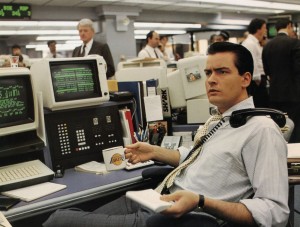
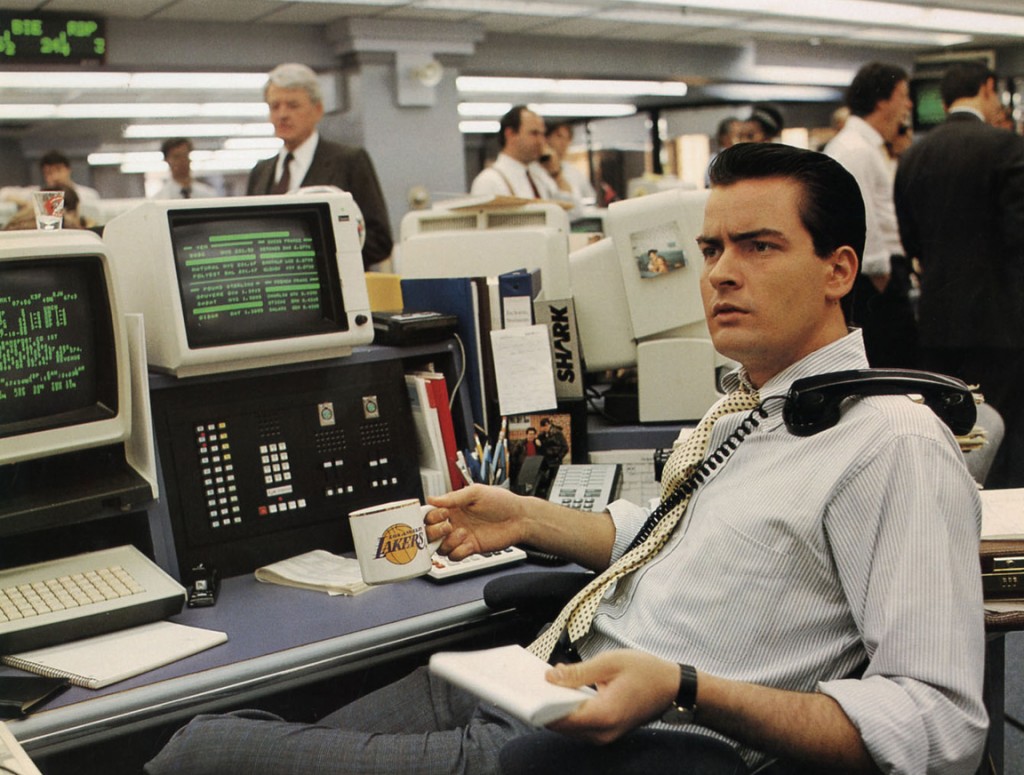
Wall Street
In 1987 it was to be Oliver Stone and Michael Douglas that gave us
the cinematic character that more than any other came to symbolize his
era. Gordon Gekko had indomitable cynicism to spare and lived the
lifestyle of conspicuous consumption. But, strictly speaking,
established and middle-aged Gekko was not the yuppie of Wall Street.
The role of young upwardly-mobile professional was that of Charlie
Sheen as the stockbroker Bud Fox. In the end, Bud Fox turns out to be
little more than a good kid led momentarily astray, whilst neoliberalism
is brushed off as the product of individual greed that can be
outmaneuvered by the collaboration of a "responsible” labour union and a
morally superior capitalist. Stone’s naïve social liberalism made sure
his ending had little resemblance to the real world of relentless
top-down class war.
Instead, the ultimate yuppie, Patrick Bateman, was brought to us in 1991 courtesy of Brett Easton Ellis in his third novel, American Psycho. That same year Time
magazine famously published the obituary of the yuppie. But that was
way, way too early. To be sure, the self-confidence of the yuppie was
shaken by the crisis of the early nineties, much as it was ten years
later by the dot com crash and 9/11, but both times he (or more rarely
she) would return with a vengeance. How could it be differently when
economic inequality was forever on the rise and finance capital kept
being treated as the all-powerful divinity whose appetites must forever
be satisfied, no matter the human cost. "Compared with us, the eighties
greedhead was practically restrained,” concluded one self-styled yuppie recently:
"If anything, your average upwardly mobile young professional has so
outstripped and outclassed the mid-eighties yuppie that if Gordon Gekko
himself were to show up in polite society in 2006, he would look kind of
provincial.”

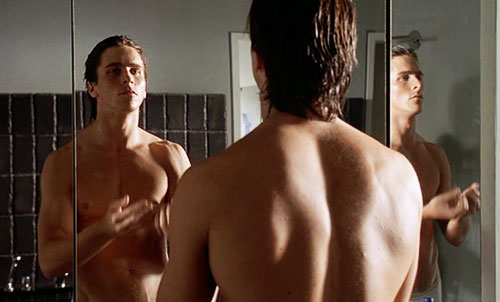
American Psycho
Today research has
taught us more than we knew thirty years ago about how inequality
destroys the humanity of us. The economic divide that places a
super-wealthy elite in a condition of invulnerability, social and
physical isolation, simultaneously blocks the ability to empathize.
The distance separating them from the rest of us becomes so great that
they simply lose the ability to see us as proper fellow humans. The
logic of the market that transforms everything and everyone into
commodities does the rest. When a yuppie looks at us we should probably
imagine that he looks at us much as we might look at a dog. Of course
there are all sorts of dogs; good dogs, cute dogs, difficult dogs,
dangerous dogs, dogs that need to be put down. This is the psychological
realism that was captured with such steely elegance by Mary Harron and
Christian Bale when they brought American Psycho to the screen
in 2000. Patrick Bateman is the image of a monstrous, deranged
neoliberalism at its peek; invincible and opaque. No matter how far into
madness Bateman takes his blood thirst the world cannot see through the
polished masque that he ritually dons every morning with the help of
his battery of ultra-exclusive skin care products.

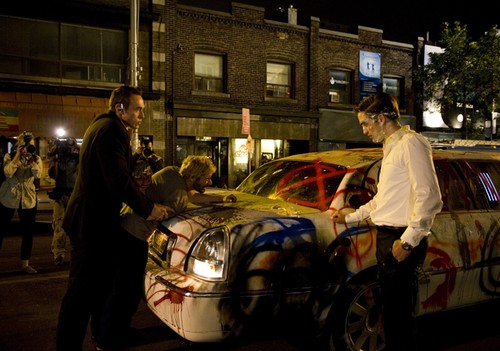
Cosmopolis
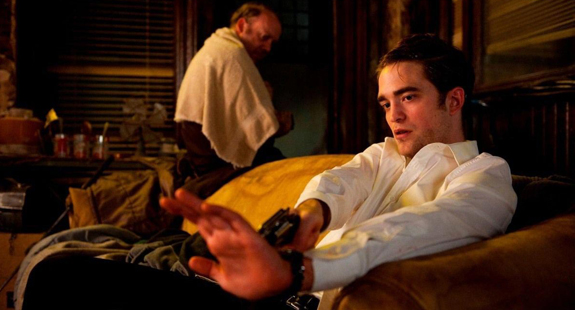
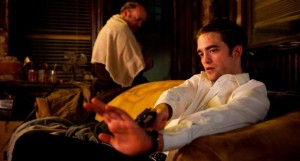
The 28-year old financial billionaire Eric Packer (Robert Pattinson),
whose continuously disrupted journey across Manhattan in a sound proof
limousine is narrated in Cosmopolis, is every bit as mentally
estranged from the everyday world around him as Bateman and just as
brutally indifferent. But Packer’s universe is falling apart around him,
assaulted both by anti-capitalist protesters and a market that suddenly
turns unpredictable. In the course of the film’s 108 minutes he loses
everything. Seen as a story about the financial crisis as such this is
obviously not a very realistic depiction. With very few exceptions, the
ultra-rich have become even richer, protected with absolute loyalty by
the neoliberal state that remains the slavishly obedient guarantor of
their wealth and power. But Cosmopolis is, perhaps, rather more
realistic if understood as the nightmare of the contemporary yuppie in a
time when neither the vulnerability of the economy in itself nor the
realization of Earth’s incapacity to sustain the capitalist production
system can be fully repressed. Perhaps, then, what we see here is the
initial crumbling of the psychological foundation of the yuppie, the
sociopathic self-confidence.
Cosmopolis
Erich Hobsbawm has spoken of "the short twentieth century,” from the outbreak of World War One to the fall of the Soviet Union. Giovanni Arrighi, on the other hand, wrote about "the long twentieth century,”
starting with the Great Depression of 1873-96. Perhaps we could also
speak of "the long 1980s” of unlimited neoliberal self-confidence,
beginning with the election of the first Thatcher government and
possibly reaching the beginning of its end with the Lehman Brothers
crash in September 2008. Then again, Eric Packer may well wake up from
his nightmare once more, like he did after the initial crisis of the
twenty-first century, the period when Don DeLillo’s here adapted novel
was written. After all, the yuppie has proven just as difficult to kill
off as those other monsters of the long 1980s, Freddy Krueger, Jason
Vorhees and Michael Myers.

 Group Home
 Blog Home
 Group Blogs
 RSS