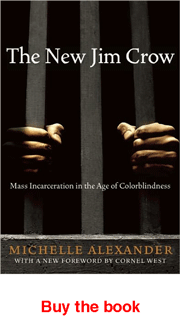
In March 2010, when TomDispatch first published a piece by Michelle Alexander, her book, The New Jim Crow: Mass Incarceration in the Age of Colorblindness,
had just been published. As I wrote then, it focused in startling ways
on "a growing racial divide, one which includes the formation of a new
undercaste in America that loses its normal rights at the prison gates
and often never recovers them.” Her piece offered nothing short of a
new way to look at racial oppression in this country in the
twenty-first century -- and in hardcover it would sell a mere 3,000
copies. But Alexander was a superb writer, had a compelling personal
story (check it out on Timothy MacBain’s riveting 2010 TomDispatch audio interview with her), and something new to tell the world -- and somehow (never discount miracles!), it broke through.
Now, the paperback of the book is a bestseller with 175,000 copies in print and Alexander has the stamp of approval of the New York Times, which recently led the front page of its culture section with a piece on her and her book ("Drug Policy as Race Policy: Best Seller Galvanizes the Debate”).
TomDispatch is proud to have been there at the beginning and to have
played a very small part in Alexander’s well-deserved success.
Unfortunately, her piece, now two years old, couldn’t feel more up to
date (and just to ensure its absolute up-to-dateness, Alexander has gone
over it and made a few additions). It’s great to have her work in our
periodic "best of TomDispatch” series. Tom
Most people don’t like it when I say this. It makes them angry. In
the "era of colorblindness” there’s a nearly fanatical desire to cling
to the myth that we as a nation have "moved beyond” race. Here are a
few facts that run counter to that triumphant racial narrative:
*There are more African American adults under correctional control
today -- in prison or jail, on probation or parole -- than were enslaved
in 1850, a decade before the Civil War began.
*As of 2004, more African American men were disenfranchised (due to
felon disenfranchisement laws) than in 1870, the year the Fifteenth
Amendment was ratified, prohibiting laws that explicitly deny the right
to vote on the basis of race.
* A black child born today is less likely to be raised by both
parents than a black child born during slavery. The recent
disintegration of the African American family is due in large part to
the mass imprisonment of black fathers.
*If you take into account prisoners, a large majority of African
American men in some urban areas have been labeled felons for life. (In
the Chicago area, the figure is nearly 80%.) These men are part of a
growing undercaste -- not class, caste -- permanently relegated, by law,
to a second-class status. They can be denied the right to vote,
automatically excluded from juries, and legally discriminated against in
employment, housing, access to education, and public benefits, much as
their grandparents and great-grandparents were during the Jim Crow era.
Excuses for the Lockdown
There is, of course, a colorblind explanation for all this: crime
rates. Our prison population has exploded from about 300,000 to more
than 2 million in a few short decades, it is said, because of rampant
crime. We’re told that the reason so many black and brown men find
themselves behind bars and ushered into a permanent, second-class status
is because they happen to be the bad guys.
The uncomfortable truth, however, is that crime rates do not explain
the sudden and dramatic mass incarceration of African Americans during
the past 30 years. Crime rates have fluctuated over the last few
decades -- they are currently at historical lows -- but imprisonment
rates have consistently soared. Quintupled, in fact. The main driver
has been the War on Drugs. Drug offenses alone accounted for about
two-thirds of the increase in the federal inmate population, and more
than half of the increase in the state prison population between 1985
and 2000, the period of our prison system’s most dramatic expansion.
The drug war has been brutal -- complete with SWAT teams, tanks,
bazookas, grenade launchers, and sweeps of entire neighborhoods -- but
those who live in white communities have little clue to the devastation
wrought. This war has been waged almost exclusively in poor communities
of color, even though studies consistently show that people of all
colors use and sell illegal drugs at remarkably similar rates. In fact,
some studies indicate that white youth are significantly more likely to
engage in illegal drug dealing than black youth. Any notion that drug
use among African Americans is more severe or dangerous is belied by the
data. White youth, for example, have about three times the number of
drug-related visits to the emergency room as their African American
counterparts.
That is not what you would guess, though, when entering our nation’s
prisons and jails, overflowing as they are with black and brown drug
offenders. In some states, African Americans comprise 80%-90% of all
drug offenders sent to prison.
This is the point at which I am typically interrupted and reminded that black men have higher rates of violent crime. That’s
why the drug war is waged in poor communities of color and not
middle-class suburbs. Drug warriors are trying to get rid of those drug
kingpins and violent offenders who make ghetto communities a living
hell. It has nothing to do with race; it’s all about violent crime.
Again, not so. President Ronald Reagan officially declared the
current drug war in 1982, when drug crime was declining, not rising.
President Richard Nixon was the first to coin the term "a war on drugs,”
but it was President Reagan who turned the rhetorical war into a
literal one. From the outset, the war had relatively little to do with
drug crime and much to do with racial politics. The drug war was part
of a grand and highly successful Republican Party strategy of using
racially coded political appeals on issues of crime and welfare to
attract poor and working class white voters who were resentful of, and
threatened by, desegregation, busing, and affirmative action. In the
words of H.R. Haldeman, President Richard Nixon’s White House Chief of
Staff: "[T]he whole problem is really the blacks. The key is to devise a
system that recognizes this while not appearing to.”
 A
few years after the drug war was announced, crack cocaine hit the
streets of inner-city communities. The Reagan administration seized on
this development with glee, hiring staff who were to be responsible for
publicizing inner-city crack babies, crack mothers, crack whores, and
drug-related violence. The goal was to make inner-city crack abuse and
violence a media sensation, bolstering public support for the drug war
which, it was hoped, would lead Congress to devote millions of dollars
in additional funding to it.
The plan worked like a charm. For more than a decade, black drug
dealers and users would be regulars in newspaper stories and would
saturate the evening TV news. Congress and state legislatures
nationwide would devote billions of dollars to the drug war and pass
harsh mandatory minimum sentences for drug crimes -- sentences longer
than murderers receive in many countries.
Democrats began competing with Republicans to prove that they could
be even tougher on the dark-skinned pariahs. In President Bill
Clinton’s boastful words, "I can be nicked a lot, but no one can say I’m
soft on crime.” The facts bear him out. Clinton’s "tough on crime”
policies resulted in the largest increase in federal and state prison
inmates of any president in American history. But Clinton was not
satisfied with exploding prison populations. He and the "New Democrats”
championed legislation banning drug felons from public housing (no
matter how minor the offense) and denying them basic public benefits,
including food stamps, for life. Discrimination in virtually every
aspect of political, economic, and social life is now perfectly legal,
if you’ve been labeled a felon.
Facing Facts
But what about all those violent criminals and drug kingpins? Isn’t
the drug war waged in ghetto communities because that’s where the
violent offenders can be found? The answer is yes... in made-for-TV
movies. In real life, the answer is no.
The drug war has never been focused on rooting out drug kingpins or
violent offenders. Federal funding flows to those agencies that
increase dramatically the volume of drug arrests, not the agencies most
successful in bringing down the bosses. What gets rewarded in this war
is sheer numbers of drug arrests. To make matters worse, federal drug
forfeiture laws allow state and local law enforcement agencies to keep
for their own use 80% of the cash, cars, and homes seized from drug
suspects, thus granting law enforcement a direct monetary interest in
the profitability of the drug market.
The results have been predictable: people of color rounded up en
masse for relatively minor, non-violent drug offenses. In 2005, four
out of five drug arrests were for possession, only one out of five for
sales. Most people in state prison have no history of violence or even
of significant selling activity. In fact, during the 1990s -- the
period of the most dramatic expansion of the drug war -- nearly 80% of
the increase in drug arrests was for marijuana possession, a drug
generally considered less harmful than alcohol or tobacco and at least
as prevalent in middle-class white communities as in the inner city.
In this way, a new racial undercaste has been created in an
astonishingly short period of time -- a new Jim Crow system. Millions
of people of color are now saddled with criminal records and legally
denied the very rights that their parents and grandparents fought for
and, in some cases, died for.
Affirmative action, though, has put a happy face on this racial
reality. Seeing black people graduate from Harvard and Yale and become
CEOs or corporate lawyers -- not to mention president of the United
States -- causes us all to marvel at what a long way we’ve come.
Recent data shows, though, that much of black progress is a myth. In
many respects, African Americans are doing no better than they were
when Martin Luther King, Jr. was assassinated and uprisings swept inner
cities across America. The black child poverty rate is actually higher
now than it was then. Unemployment rates in black communities rival
those in Third World countries. And that’s with affirmative action!
When we pull back the curtain and take a look at what our
"colorblind” society creates without affirmative action, we see a
familiar social, political, and economic structure: the structure of
racial caste. The entrance into this new caste system can be found at
the prison gate.
This is not Martin Luther King, Jr.’s dream. This is not the
promised land. The cyclical rebirth of caste in America is a recurring
racial nightmare.
Michelle Alexander is the author of the bestselling book The New Jim Crow: Mass Incarceration in the Age of Colorblindness
(The New Press, 2010). The former director of the Racial Justice
Project of the ACLU in Northern California, she also served as a law
clerk to Justice Harry Blackmun on the U.S. Supreme Court. Currently,
she holds a joint appointment with the Kirwan Institute for the Study of
Race and Ethnicity and the Moritz College of Law at Ohio State
University. To listen to a TomCast audio interview in which Alexander
explains how she came to realize that this country was bringing Jim Crow
into the Age of Obama, click here.
Follow TomDispatch on Twitter @TomDispatch and join us on Facebook.
Copyright 2012 Michelle Alexander

 Group Home
 Blog Home
 Group Blogs
 RSS


