| |
SOCIETY FOR CINEMA AND MEDIA STUDIES RESOURCES
TEACHING
Resources for Teaching Film and Video Courses
by Frank P. Tomasulo, SCMS Committee On Teaching
Note: This document was originally in Cinema Journal 34, No. 4, 1995. � University of Texas Press, P.O. Box 7819, Austin, TX 78713-7819
Most members of the Society for Cinema Studies earn their livings
(or hope to earn their livings) teaching film at colleges and
universities. Many hold doctoral degrees or are in the process of
attaining the Ph. D. The scholarly and research activities that we
all engage in ultimately add to the growing body of knowledge and
understanding about the cinematic and televisual media. Film
scholarship has certainly been highlighted by the SCS through its
annual conferences, Cinema Journal, and the organization's many
committees and activities. Film pedagogy, however, has not always
received the attention it deserves in our academic discipline,
given that most of us, in addition to our myriad writing and
research pursuits, are also actively engaged in teaching
undergraduate or graduate saldents. With that fact in mind, the
Committee on Teaching of the Society for Cinema Studies hopes to
place renewed emphasis on practical pedagogy within the context of
the specificity of the cinema studies field.
Although some doctoral institutions in our field provide a modicum
of mentoring in pedagogical techniques before unleashing their
graduates onto unsuspecting film students around the country, many
do not. Those enlightened universities that do provide some form
of teaching instruction to their doctoral or M.F.A. candidates
usually confine those efforts to an informal pep talk about local
procedures or an occasional classroom visitation by a regular
faculty member to the graduate student's discussion section,
followed by a written report or casual conversation. Sometimes,
the teaching assistant's class is videotaped and analyzed by one
of the senior faculty members of the department. But more often
than not, the fledgling film instructor is taught how to teach the
same way I was taught how to swim--by being thrown into the deep
waters without any formal instruction or preparation. (By the way,
I sank to the bottom of the pool when this method was tried on
me.)
Thanks to the efforts of the SCS Committee on Teaching and Cinema
Journal, beginning cinema instructors (and even some old hands)
can now avail themselves of both traditional and cutting-edge
ideas and resources that can improve their pedagogical abilities.
The very nature of the medium of film and the various critical and
theoretical methodologies that have been developed to study it
require that the academic film community be involved with
technology, international distribution patterns, and cross
disciplinary teaching perspectives. As a committee, we plan to
offer numerous opportunities to discuss teaching strategies and
resources: workshop presentations at the annual SCS conferences, articles in Cinema Journal, and brief teaching
suggestions in regular SCS mailings. But we do not want this
information exchange to be a one-way communication; the SCS
Committee on Teaching welcomes your input: questions about (and
answers to) common teaching problems, effective strategies for
teaching all sorts of cinema courses, resources that you've found
useful or have devised yourself, and teaching topics for general
discussion among the membership. A partial list of issues might
include course development; curricular design; textbook selection;
essay, true-false, or multiple choice exams; term paper topics;
the "canon" and multiculturalism; race/gender/class/sexual
orientation issues; techniques for facilitating discussion;
professor-student dynamics; motion picture, videotape, and
laserdisc resources; the role of computers and new technologies in
the film classroom or library; the role of theory in film
production classes (and vice-versa); research facilities and
databases; and interpersonal aspects of communicating in a lecture
hall or seminar room. These questions represent only a partial
list of concerns that could provoke revived interest in teaching
cinema studies for both newcomers to the profession and senior
faculty members. So, please read our articles, attend our
workshops, and join us in sharing pedagogical resources and
techniques.
Teaching the Introductory Cinema Studies Course: Some
Strategies and Resources
by Frank P. Tomasulo
Any subject can be taught effectively in some intellectually
honest form to any [person] at any stage of development.--
Jerome Bruner, The Process of Education
For undergraduate students, the introductory cinema studies course
is often the first exposure to learning about the formal
properties of the art/medium of film. Frequently, it is also the
junior faculty member's first exposure to teaching film. Whether
taught in a large lecture hall or a small seminar room (or some
combination of the two), a successful beginning cinema class can
instill basic concepts and establish habits of mind that can
affect a lifetime of further study and film viewing for the
student and a lifetime of effective pedagogical practice for the
instructor.
In order to foster Bruner's goal of teaching "effectively" to "any
[person] at any stage of development," I will focus here on some
rather low-tech and even retro methods for enhancing interest and
retention in the introductory cinema studies course, where student
interest and ability may vary widely within a given class. I
assume that whatever else is being taught in such a course
(history, ideology, feminism, industry, theory, genre, writing
skills, production) etc.) some emphasis is placed on the
aesthetics and semiotics of the moving image,
that is, that the film text is treated as a signifying system with
formal codes and conventions that produce/determine meaning and
that the relationship between style and ideology is analyzed (and
emphasized) in classroom discussion and written assignments. To
the extent that the course offers students some methodology for
reading and understanding cinematic imagery and equipping them
with a means to confidently order their responses to it, the
following suggestions and materials might be of interest.
Sample Syllabi. Two books edited by Erik S. Lunde and Douglas A.
Noverr--Film Studies and Film History (both New York: Markus
Wiener, 1989)--contain dozens of sample syllabi designed by
scholars in the cinema studies field, including Vivian Sobehack,
Gerald Mast, E. Ann Kaplan, Robert Sklar, Miriam Hansen, Louis
Giannetti, and Diane Carson. These collections contain many sample
course outlines for introductory classes and more specialized
offerings.
Another source for sample syllabi are the "Course Files" regularly
published in the Journal of Film and Video, which should be
required reading for beginning film professors A wide variety of
film production and cinema studies syllabi are featured, complete
with extensive reading lists, filmographies, modules, sample
assignments, rationales) and week-by-week descriptions of the
learning experience. A collection of such course files has been
assembled and edited by Patricia Erens as University Film and
Video Association Monograph #5, available for $9.00 ($4.50 for
UFVA members) from the Editor, Journal of Film and Video
Department of Communication, Georgia State University, Atlanta, GA
30303, (404) 651-3200.
Needless to say, one should use these samples as models only and
not plagiarize from them in constructingting ones own course
outline. Colleges and universities often expect their new
appointments to teach the large-enrollment, lower-division "intro"
classes. Thus, having an original syllabus ready, even before
landing that first academic position, can be an invaluable aid for
the newly minted Ph.D. On the job market. Demonstrating that one
has at least thought about the organization of such a course and
has even prepared a course outline manifests an abiding interest
in teaching and a professional devotion to cinematic pedagogy.
Student Writing. Another pedagogical tool I have found useful is
to put sample A papers On reserve in the library at the start of
each term. This demonstrates to students that undergraduates
are capable of in-depth film analysis and clear writing. These
papers can he obtained from former students (this sometimes
reqttires written approval), the chapter on "Writing College
Papers about Film" (pp. 422 65) in Vivian and Thomas Sobchack's An
Introduction to Film (Boston: Little, Brown, 1987), or Timothy
Corrigan's excellent book A Short Guide to Writing about Film
(Boston: Scott, Foresman, 1989). Most film analysis courses
require several writing assignments, yet general writing skills
are rarely taught in cinema studies classes: thesis statement,
literature review, organization,
spelling and grammar, citations, research skills, etc. A simple
"Dos and Don'ts" handout or tip sheet on writing about film may
help, and being able to point to specific guidelines that the
student did not follow can be valuable if a student appeals a
grade. (It might also be useful to prepare such a document for job
applications since it shows a concern for student writing and
learning.)
Film Clips. The Macmillan Film Study Extract series is a
selection of twenty 16-mm. film clips from canonical narrative and
documentary films that illustrate various cinematic techniques.
Each six- to sixteen-minute clip comes with a highly useful
brochure that is filled with valuable information and frame
enlargements. Montage editing can be studied in the Odessa steps
sequence from The Battleship Potemkin and the last-minute rescue
scene from Way Down East; sound in M and the Seraghina or
steambath sections of 81/2; mise-en-scene in the statues sequence
from Last Year at Marienbad, the murder of Batala scene in The
Crime of Monsieur Lange, and the opening of Eclipse; set design in
the Jane's abduction sequence from The Cabinet of Dr. Caligari and
Anastasia's filneral in Ivan the Terrible; camera movement in the
opening of Triumph of the Will and the three women, three bombs
section of The Battle of Algiers; cinematography and lighting in
the drunken dream scene in The Last Laugh and the razor sequence
from Spellbound; gaze-object-gaze editing in the key sequence from
Notorious and the mother's visit to the prison scene in Mother;
music in The World of Apu's honeymoon scene and La Bete Humaine's
murder of Severine section; and fantasy elements in the dormitory
revolt from Zero for Conduct and the spirit scene in Throne of
Blood.
The clips can be used in other ways as well. Since two Hitchcock,
Renoir, and Fellini clips are included in the series, the two
sequences can be juxtaposed to illustrate auteurist consistency of
style and theme. The two German Expressionist scenes can be
coordinated to show the differences between Caligari and The Last
Laugh. The Triumph of the Will extract can be juxtaposed with The
Battle of Algiers clip to spark discussion on "realism." In short,
the extracts can be mixed and matched to demonstrate comparisons
and contrasts between directorial styles.
Beyond that, each clip can be used to represent more than just a
single primary film technique; indeed, each of the brochures has a
detailed analysis of all the formal elements in the clip. These
booklets also contain sections that discuss the historical and
cultural context of the film, provide an ideological and thematic
overview, follow recurring motifs, define the director's style,
and contain a brief bibliography. Most of the brochures have
extensive shot-by-shot illustrations to intensify and exemplify
the textual analysis. If one has a 16-mm. analytic projector or
uses clips culled from a videotape or laserdisc, one can freeze
frame the images that are illustrated in the booklet for in-depth
study in class.
The clips and booklets are available from the Extension for
Media and Independent Learning, University of California-Berkeley,
2000 Center
Street, Berkeley, CA 94704; (510) 642-0460 and a few other
university media resource centers throughout the nation. They
usually rent for about $30 each for classroom use.
Educational Video Series. Two important video series contain
feature-length films as well as discussions and/or lectures on the
individual film and filmmaker. The Cinematic Eye series is
available through the South Carolina Educational Television
Network. This series originally included thirteen international
classics--Shoeshine, La Strada, L'Avrentura, Hobson's Choice, Man
of Aran, Rules of the Game, Cocteau's Beauty and the Beast, Jules
et Jim, The Cabinet of Dr. Caligari, M, Torment, Smiles of a
Summer Night, and The Battleship Potemkin--;and two thorough study
guides that include background information on the historical
context, production data, significance, and techniques of the
individual films. Benjamin Dunlap provided a lecture before and
after each selection. Although the series was originally produced
and aired on public television in 1977, the insights are still
relevant. Now only four of the films are available from SCETV: The
Cabinet of Dr. Caligari, M, Torment, and The Battleship Potemkin.
They can be purchased from South Carolina Educational Television,
Marketing Department, Box 11000, Columbia, SC 29211; (803)
7373200). The cost is $69.95 per videotape (all four for $250.00).
SCS member Jerry Carlson has produced a more recent series
featuring fourteen classic films specifically designed for an
introductory film class. Indeed, his telecourse, Introduction to
Film Studies, features an hour-long discussion between Carlson and
a prominent film scholar on each film in the series. Some of the
speakers are Alan Williams (Shoot the Piano Player), Stuart
Liebman (Charade), Elisabeth Weis (The Secret Agent), George
Custen (The Third Man), Anthony Pipolo (Blood of a Poet and Ballet
Mechanique), Leonard Quart (It's a Wonderful Life), Dennis DeNitto
(The Battleship Potemkin), Jonathan Buchsbaum (Last Year at
Marienbad), and Kristin Thompson (College). The films and
discussions are keyed to readings in the course textbook, David
Bordwell and Kristin Thompson's Film Art: An Introduction, 4th
edition (New York: McCraw-Hill, 1993).1 The other films in the
series are Mon Oncle, Grand Illusion, La Notte, His Girl Friday,
and Detour. SCS members interested in obtaining any of these
videotapes at a modest cost can contact Jerry Carlson at City
University Television/CUNY-TV, 25 West 42nd Street, Suite 1220,
New York, NY 10036; (212) 719-9128.
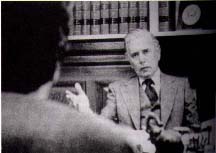
Use of Slides in the Classroom. Despite the optimistic
assumption that "Generation X" students are thoroughly
media-literate, ample evidence indicates otherwise. The quotidian
reality (even banality) of many students' first papers is enough
to call into question the repeated bromide that today's students
"bring to film a strong visual orientation and at least a
rudimentary visual literacy."2 Students may have been widely
exposed to media imagery, but they may not understand film
"language." Encouraging students to think cinematically
still involves breaking some habits they may have acquired over a
lifetime of watching films and television as entertainment.
"[It is] not the professor, but the artist who is the true
schoolmaster" (Herbert Read, Education through Art). In
line with this quotation and the goal of improving cinematic
literacy, I strongly recommend the use of slides, made directly
from film prints, in the introductory film classroom. Frame
enlargements display the artistry of the filmmaker in a format
that allows for relaxed study and attention to style and meaning.
Although video and film clips are important adjuncts to the
screening of complete films, the use of slides allows the class to
freeze-frame a single image (or group of related shots) and study
its formal properties in detail: the camera angle, mise-en-scene,
point of view, lighting, set design, costuming, makeup, and props.
Details that were not noticed during the screening can be pointed
out and analyzed (for instance, the small statue of an elephant,
symbol of the Republican Party, on the desk of a "lawand-order"
judge in . . . And Justice for All, or the name "Crusader" and the
knight's iron mask painted on the sled Mr. Thatcher gives young
Charles Foster Kane as a Christmas present in Citizen Kane).
Narrative and visual motifs can be highlighted by juxtaposing
images from different parts of a given film (e.g., the repeated
restaurant, automobile, and lobster scenes in Annie Hall that show
the progress and decline of the characters, or the various
psychosexual motifs in Meshes of the Afternoon). Production
students can be queried about the
location of key and fill lights (and the reasons for that
placement) while the slide is held on screen (Red Desert has been
particularly useful in this context).
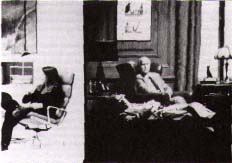
One image that I find particularly useful to analyze in class is
the splitscreen psychiatrists' sequence in Annie Hall: the
differences between the male and female protagonists is spelled
out in the set design, color scheme, lighting, and positioning,
even though they are both engaged in the same activity. Annie
Hall's side of the screen is brightly lit, with modern, white
furniture; Alvie Singer's portion is dimly lit, with heavy wooden
furniture and decor. She is sitting up, capable of quick movement
and adjustment; he is recumbent on the analyst's couch, physically
and emotionally incapable of change. Annie's psychiatrist is
off-screen, a visual clue that Annie is not totally dependent on
her; Alvie's analyst occupies the strong, dominant screen-right
position of the frame, privileging the doctor's power over Singer.
Slides can be produced directly from 16-mm. prints by using a
device called the Duplikin II, a tubelike instrument that screws
into a standard 35-mm. single lens reflex still camera instead of
your regular lens. All you need is a still camera (loaded with
slide film), a moderate light source, and the Duplikin. First,
find the frame you want to "capture" (there is no need to cut the
film), then insert the frame into the front end of the Duplikin
(making sure that the film's sprockets engage with the tooth on
the Duplikin). Aim your camera at a
light source (a 250-watt 320-degree Kelvin bulb is ideal for
reproducing color films), and adjust your exposure by moving the
apparatus closer to or farther away from your light source, based
on the readings of your built-in meter. There is no need to adjust
focus, since the Duplikin holds the movie film in a rigid support
.
The Duplikin II device for converting 16-mm. frames into slides
(or prints) can be obtained from Century Precision Cine/Optics,
10713 Burbank Boulevard, North Hollywood, CA 91601; (818) 766
3715. It lists for $495.00. An adapter ring (included in the
price) may be necessary to fit the Duplikin onto your particular
35-mm. still camera body, so be sure to specify which camera body
you own.
Notes
1. Software for a teaching program and study guide keyed to the
Bordwell and Thompson textbook, as well as to Louis Giannetti s
Understanding Movies, 6th ed. (Englewood Cliffs, N.J.: Prentice
Hall, 1993), is now available. "Film/TV Analysis: The Meaning of
the Moving Image" is an introductory film studies tutorial devised
by SCS member Timothy Garrand that provides individualized
instruction on film terminology, cinematography, lighting and
color, editing, sound, acting, narrative structure, theories, and
other key concepts. It features questions and answers and numerous
examples of the various techniques. Currently on floppy disk only,
the program will be available in a CD-ROM version in 1995. The
software can be purchased from Academic Software Corporation, 446
Bull Hill Road, Conesville, NY 12076; (800) 666-3652. The cost is
$20.00 for teachers and $25.00 for students.
2. Joy Gould Boyum and Gordon Pradl, "The Necessary Balance in
Teaching Film," English Journal 63 (October 1974): 52.
See also ScreenSite's list of mailorder video
sources.

|