This website uses cookies to store information on your computer. Some of these cookies are used for visitor analysis, others are essential to making our site function properly and improve the user experience. By using this site, you consent to the placement of these cookies. Click Accept to consent and dismiss this message or Deny to leave this website. Read our Privacy Statement for more.
The Victoria and Albert
Museum has acquired an archive of materials from the grandchildren of
Vivien Leigh. The archive includes diaries, scrap books, heavily annotated
scripts, hundreds of rare early color photographs that Leigh took herself while
on tour, and thousands of letters to a wide circle of friends and acquaintances
that included the Queen Mother, Graham Greene, and Winston Churchill. These
materials encompass her life and work, from her teen years to her death from
tuberculosis in 1967 at age 53.
The National Film Preservation Foundation (NFPF), George
Eastman House, the Cineteca del Friuli, and Cinemazero announced the recovery of Orson
Welles’s Too Much Johnson (1938), filmed two years before the American
director made Citizen Kane (1941). Never finished, the film did not
screen publicly and took on legendary status when the only known print
reportedly burned.
Too
Much Johnson was originally intended to be screened in
conjunction with the Mercury Theatre stage adaptation of an 1894 play by
William Gillette. The three-part slapstick film was meant to be shown as
prologues to each act of the play with the accompaniment of music and live
sound effects. Joseph Cotten was cast in the lead role, with supporting roles
going to Mercury Theatre actors, including Eustace Wyatt, Edgar Barrier, Ruth
Ford, Arlene Francis, Mary Wickes, Orson Welles, and his wife Virginia
Nicolson. The play ultimately opened without the film on August 16, 1938, and
flopped.
When discovered, the nitrate print of
the film was given by Cinemazero to the Cineteca del Friuli. From there, it was
transferred to George Eastman House in order to be preserved with a grant from
the National Film Preservation Foundation. The original nitrate print of Too Much Johnson will reside at Eastman
House’s Louis B. Mayer Conservation Center, one of the repositories for the
museum’s collection of 28,000 films. The bulk of Eastman House’s preservation
work for Too Much Johnson was
completed at Cinema Arts, a film laboratory in Pennsylvania specializing in the
restoration of archival material.
Too Much Johnson had
its international premiere at Le Giornate del Cinema Muto, in Pordenone, Italy, on
October 9. George Eastman House hosted the U.S. premiere on October 16.
For more information about the film, its discovery, and
restoration see here,
here,
and here.
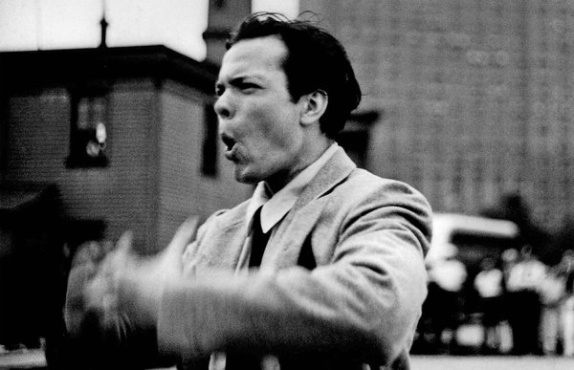
[Above: Orson Welles directs Too Much Johnson. AMPAS]
The Motion Picture Preservation Lab (MPPL) at the American National
Archives and Records Administration (NARA) recently completed its preservation
and digital restoration of The March (James
Blue, 1964). The film documents the 1963 March on Washington for Jobs and
Freedom. It
was named to the National Film Registry in 2008 and, that same year, the reels arrived
in the lab and preservation processes began. In honor of the fiftieth
anniversary of The March for Jobs and Freedom, the lab completed a full digital
restoration.
The restored digital theater copy of The March was shown in the
McGowan Theater at the National Archives building in Washington, D.C. on August
26, 27, and 28. The March
is also available online (linked above).
For further details on the history of this film and the
restoration and preservation processes, see Criss Kovac’s account on Media
Matters.
National Film Archive of India Restores Sri
Lankan Classic
After the restoration of Uday Shankar's 1948 film Kalpana in
2012, the National Film
Archive of India (NFAI) has once again collaborated with the World Cinema Foundation (WCF).
This time, they have come together to restore the Sri Lankan film Nidhanaya (Lester James Peries 1972).
The restored print of the movie is going to be screened in the Venezia Classici
category at the Venice
International Film Festival this year. The restoration work of the film is
being done at L'Immagine Ritrovata
laboratory in Cineteca Bologna, Italy.
For further details on the project, see the Times
of India.
The US Copyright Office presented a Copyright Matters program on July 29, 2013. The program was
entitled "Copyright Conversations with the United Kingdom” and was held in the
Library of Congress, Washington, D.C.
The program featured John Alty, chief
executive officer and comptroller general of the Intellectual Property Office
of the United Kingdom, as well as Neil Feinson, director of international
policy, and Adam Williams, deputy director of international policy. In a
conversation with Register of Copyrights Maria A. Pallante and senior officials
of the US Copyright Office, the panelists discussed current copyright policy
issues facing the United Kingdom and the United States, such as orphan works,
extended collective licensing, small claims, and recent efforts in both
countries to update the copyright legal system for the digital age.
Congress Holds Two Hearings on "Innovation in
America”
In July and August,
the American Congressional Subcommittee on Courts, Intellectual Property, and
the Internet held two hearings on the theme of "Innovation in America.” The
first hearing gathered testimony on the role of copyrights; the second gathered testimony on the role of technology in America.
Emile De Antonio
Collection Accessible after Yearlong Project
The Wisconsin
Center for Film and Theater Research recently announced the completion of
their year long project to fully process the collection of celebrated American
documentary filmmaker Emile de Antonio (1919-1989). Spanning 119 cubic feet, the
collection was developed over twenty-seven years, from 1971 to 2008, in 106
separate installments. Funded by a grant from the National Historical Publications and Records
Commission, the processing project increases access to the diverse materials
within the collection.
Emile de Antonio became involved in filmmaking in the late
1950s as a distributor for Pull My Daisy (Robert
Frank and Alfred Leslie, 1959). His first feature film was Point of Order (1964), constructed from kinescopes of the
Army-McCarthy hearings. This documentary style—combining newsreel footage,
television outtakes, and interviews—marked much of his work, though later films
would play with this structure by including reenactments or featuring the
filmmaker himself.
The collection reflects de Antonio’s personal and professional
life, and includes material on every film project he made and several
uncompleted works. It also reflects his role as an advisor, editor, and mentor
to many other filmmakers, his participation in leftist political groups, and
his research interests in revolutionary movements, the modern art world, and
documentary and independent film production.
Retrospective screenings and an online
exhibition celebrating Emile de Antonio and the conclusion of the project are
scheduled for Fall 2013 and Spring 2014.
Bradford National
Media Museum Becomes Seventh BFI Mediatheque
Yorkshire’s only British
Film Institute (BFI) Mediatheque recently opened at the National Media Museum,
Bradford. The BFI Mediatheque is a free facility that allows members of the
public instant access to more than 2,500 British film and television programs,
drawn from the collections of the BFI National Archive and
partner archives, including a selection from the National Media Museum’s TV
Heaven collection and the Yorkshire
Film Archive.
A collection of material relating to the Yorkshire and
Humber area, entitled God’s Own County: Yorkshire on Screen, was
unveiled as part of the launch. The collection features one hundred film and
television programs from both the BFI National Archive collections and the
holdings of the Yorkshire Film Archive. Highlights of God’s Own Countyinclude a filmic journey through
Victorian Bradford in 1896; a turn-of-the-century Punch and Judy show in
Halifax; home movies of Hull’s pioneering aviator Amy Johnson; and feature film
depictions of the region, including Billy Liar (John Schlesinger,
1963) and Brassed Off (Mark Herman, 1996).
European Film
Restoration Labs Thrive on Asian Projects
Italy’s L’Immagine Ritrovata reports that twenty percent of its projects
are now Asian, as the region’s film archives and studios have begun to conserve
their classics and back catalogs. This year, the laboratory has finished
work onManila: In the Claws of Neon (Lino Brocka, 1975),
a joint project from Cineteca di
Bologna and World Cinema
Foundation, and Nobody’s Child (Bu Wancang, 1960),
a Hong Kong Film
Archive commission that premiered at the city’s international film festival
in April. L’Immagine Ritrovata is
now working on the Malaysian film Dang Anom (Husain
Haniff, 1962), as well as a handful of titles from the region, which
have yet to be publicly announced. The demand for expertise in film restoration
and preservation has also spurred collaborations between European training
programs and Asian museums and universities.
The Academy of Motion Picture Arts and Sciences announces the gift of the Abe and Charlotte Levitow Collection, which features animation art and
related production materials that document the career of animator Abe Levitow.
Donated by the Levitows’ children, the collection features animation cels,
backgrounds, storyboards, graphic art materials and related film prints—hundreds
of items that represent Levitow’s work as an artist, animator, and director for
Warner Bros., UPA, and MGM. The collection, which will be housed in both the
Academy’s Margaret Herrick Library and the Academy Film Archive, is a significant addition to the Academy’s holdings in the
field of animation.
All of the production materials may be
accessed at the library, which is located in the Academy’s Fairbanks Center for Motion Picture
Study in
Beverly Hills. Many of the pieces in the Levitow Collection are available for
viewing online through the Library’s Production Art Database.
Additional information about Abe
Levitow can be found here. Further details on the gift can be found here.
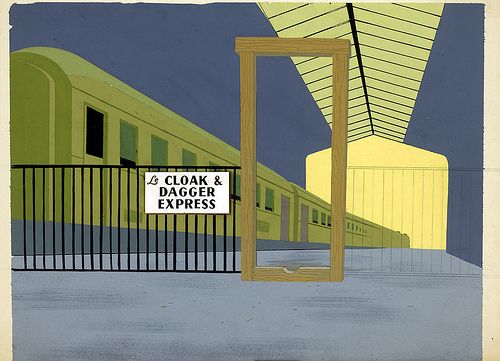
[Above: A Levitow background from Boston Quackie (Robert McKimson, 1957)]
Long-Lost Mary
Pickford Premieres at Keene State College
On October 11, Their First Misunderstanding (Thomas H. Ince and George Loane Tucker, 1911) premiered at Keene State College in Keene, New Hampshire. The
short film stars Mary Pickford in her first credited role. Pickford also wrote
the film’s scenario and co-stars with her first husband, Owen
Moore. The film was found seven years ago in a decaying barn in the
small New Hampshire town of Nelson. The Library of Congress (LoC) funded the restoration project.
For further information on the film’s
restoration and exhibition, see LATimes, HuffPo, and KSC News.
[Above: An Associated Press report on
the discovery of Their First
Misunderstanding,featuring an
excerpt from the film]
MoMA Showcases Newly
Restored Masterworks and Rediscoveries
From October 9 through November 12, the
Museum
of Modern Art
presented "To Save and Project: The 11th MoMA International Festival of
Film Preservation," an
annual festival of newly preserved and restored films from archives, studios,
distributors, and independent filmmakers around the world. This year’s festival
included more than seventy-five feature films and short subjects from twelve
countries, virtually all of them New York or international premieres, and some
shown in versions never before seen in the United States. "To Save and Project”
is committed to presenting nearly every film in its original celluloid format. Festival
co-founder and Associate MoMA curator Joshua Siegel organized the event.
Spanning a wide array of genres, this
year’s offerings feature selections by filmmaker Alexander Payne; recent MoMA
preservations; a weeklong run of Mikko Niskanen’s Finnish television miniseries
Eight Deadly Shots (1972), together
with Peter Von Bagh’s documentary portrait The
Story of Mikko Niskanen (2010); film noir; animation; a 75th anniversary
tribute to the Royal Film Archive of Belgium; and experimental cinema, including
several never-before-seen Andy Warhol film shorts from 1963.
Korean War Film Gets
First Screening in Six Decades
The Street of the Sun (Min
Kyoung-sik, 1952) a fiction film shot during the Korean War in Daegu, a
southeastern city secured by US and South Korean forces, was screened on the
sixty-third anniversary of the start of the war at the Korean Film Archive (KFA). Street of the Sun was thought to have
been destroyed or lost, along with thirteen other South Korean films made
during the war. However, the director's daughter-in-law, Seong Ryeong-chul,
found the 16mm film in a closet at her home two decades ago.
Even after the discovery, well over a decade passed before
the KFA became aware of the film. Seong contacted the organization in 2009 and
granted the film to the archive in 2012. The audio has never been found.
From October 31 through November
24, the National Film Center (NFC) of Japan hosted "Little Known Japanese
Cinema,” the sixth installment of an ongoing series that showcases films from a
newly acquired collection of films from several major Japanese studios. The series
focuses on films that have become available for screening thanks to
preservation work conducted by the NFC.
"Fassbinder – NOW. Film and Video Art” Opens
at Deutsches Filmmuseum
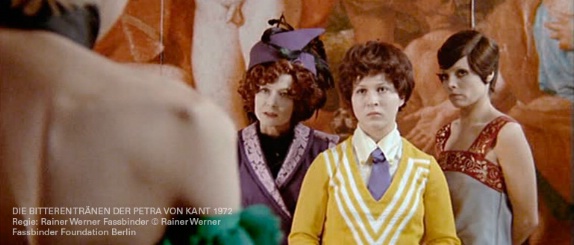
The exhibition
"Fassbinder—Now. Film and Video Art” opened on October 30 at the Deutsches Filmmuseum
and will continue until June 1, 2014. "Fassbinder—Now” explores the sustained significance and influence of
Rainer Werner Fassbinder by juxtaposing his films against video art by Tom
Geens, Runa Islam, Maryam Jafri, Jesper Just, Jeroen de Rijke / Willem de
Rooij, and Ming Wong.
In cooperation with
the Rainer Werner Fassbinder Foundation, the exhibition includes many original
documents from the Rainer Werner Fassbinder Archive, illuminating the director’s
work methods. There is an accompanying retrospective in the Filmmuseum’s
cinema, as well as a film series that showcases Fassbinder's influence on
contemporary cinema, from Pedro Almodóvar to François Ozon.
Further information
about the exhibition and the contributing artists can be found at the Deutsches Filmmuseum.
Tate Screens John Cage and Other Discoveries
from CVM
In September, the Tate Modern screened two John Cage/Richard Lippold films
that were recently restored by the Center for Visual Music (CVM) with support from the National
Film Preservation Foundation (NFPF). The program also includes new
restorations of Oskar Fischinger’s early filmsSpirals (1926)andOrnament Sound (1932); rare works
by Jordan Belson, including Bopscotch (1952),
Quartet(1983) and the premiere
of the restoration of the infamousLSD (1962);and Charles Dockum’sMobilcolor
Performance (1970), a later color-light projection composition.
The Reel
Thing
technical symposium was held on August 21–23 in Los Angeles. The event
showcased the latest technologies in audiovisual restoration and preservation
and brought together laboratory technicians, archivists, and preservationists
for a series of lectures, discussions, and screenings. Grover Crisp and Michael Friend curated the event.
All proceeds from The Reel Thing benefit the Association
of Moving Image Archivists
(AMIA).
More information and a complete program
are available here.
NFPF Announces Avant-Garde
Masters and Preservation Grants
The 2013 Avant-Garde Masters Grants will save a Joseph Cornell film discovered
in a box left by the artist and landmark experimental works by four other
filmmakers. The grants are awarded by The Film Foundation and the National Film Preservation Foundation (NFPF). Sixteen films in total will be
preserved and made available through the 2013 grants.
The Avant-Garde Masters Grants program has
funded the preservation of significant American avant-garde films for eleven
years. The grants have preserved works by fifty-three artists, including Kenneth
Anger, Samuel Beckett, Shirley Clarke, Bruce Conner, Oskar Fischinger, Hollis
Frampton, Ernie Gehr, George and Mike Kuchar, and Carolee Schneemann.
The NFPF also awarded
preservation grants to twenty institutions in thirteen American states. Among
the thirty-three films slated for preservation are Climbing Jacob’s Ladder
(1987), a documentary exploring the role of African American church museums in
preserving history; the final episode of the Boris Karloff serial The King
of the Kongo (1929), united with its sound disc for the first time in
decades; three silent-era Hollywood shorts (1919); Day of the Dead
(1957), an award-winning documentary from the Eames Studio; Escape to
Montana’s Glacier Park (ca.1970); avant-garde works by El Paso filmmaker
Willie Varela; and 1922 sound-on-film experiments by Joseph Tykociner.
For a full list of preservation grant recipients, see here.
NDSA Releases 2014
National Agenda for Digital Stewardship
The National Digital Stewardship
Alliance (NDSA)
released the 2014 National Agenda for Digital
Stewardshipin conjunction
with the 2013 Digital Preservation conference. The Agendaintegrates the perspective of dozens of
experts and hundreds of institutions to provide insight into emerging
technological trends, gaps in digital stewardship capacity, and key areas for
development. The Agenda is designed to generate comment and
conversation over the coming months in order to impact American policies and strategies
related to digital preservation and to ensure that digital content of vital
importance is acquired, managed, organized, preserved, and accessible.
In Film Restoration: The Technology and Culture
of Audio-Visual Heritage(Palgrave
Macmillan, 2013), Leo Enticknap engages with current debates on audio-visual
artifacts and identifies the ways in which traditional methods and approaches
within film studies, history, and cultural studies fail to provide the tools
needed to study and criticize restored films meaningfully. The book also
includes a technical glossary of terms related to the processes of film
restoration.
BFI Releases 11th
Volume in British Transport Series
In August, the British Film
Institute (BFI) released Experiment Under London, the
eleventh volume in the British Transport DVD collection. This volume marks London Underground's 150th anniversary. It includes
five films known collectively as The Victoria Line Reports, which were produced
by British Transport Films for London Transport. Made between 1961 and 1969,
The Victoria Line Reports document the construction of the Victoria Line from
the initial stages of design to its Royal opening.
UVA Library Opens Access to Archive of
Historical TV News Footage
After a five-year effort by to
digitally preserve what is believed to be the only surviving TV news archive of
original film clips from Virginia’s civil rights era, the University of Virginia Library launched an online collection of
historic news footage and anchor scripts from Roanoke’s WSLS-TV. The
audiovisual archive includes 20 years of WSLS news stories broadcast from 1951
to 1971. According to a Library of Congress estimate, less than ten percent of
local news film from this time period survives.
The WSLS news film collection is
available to the public through the library’s online catalog, Virgo.Each
news story is searchable by both keywords and controlled subject terms. The
collection also can be searched by the dates of the news stories. The first
3,600 news clips of the WSLS-TV News Film Collection are online already at the collection’s Virgo homepage. The rest of the estimated 13,000 clips
and 18,000 pages of anchor scripts will be uploaded through the remainder of
the year.
An online
exhibit page offers another entry point with a smaller selection
of news clips and scripts related to the desegregation of public schools, the
Cold War, "Scenes of Mid-20th Century America,” and other topics.
Lantern and Variety
Magazine Arrive at Media History Digital Library
In August, David Pierce and Eric Hoytannounced
the arrival of Lantern, the search and
visualization platform for the Media
History Digital Library (MHDL). This new MHDL feature coincided with the
addition of the first twenty years of Variety
magazine (December 1905–February 1926) to its collections. The MHDL digitizes
classic media periodicals that belong in the public domain for full public
access. The Lantern project is an open-access co-production of the University of Wisconsin-Madison
Department of Communication Arts and the MHDL.
For a complete list of the MHDL’s searchable collections,
see here. For more
information about the project and its history, see here and here.
WITNESS
Launches Activist’s Guide to Archiving Video
WITNESS recently
launched The Activists’ Guide to Archiving Video, a website that provides practical steps for
managing, storing, sharing, and preserving digital video. WITNESS is an
international non-profit organization dedicated to the use of visual
technologies in documenting human rights abuses around the world. The
Activists’ Guide was developed for human rights advocates, small media
collectives, and activistswho are creating, collecting, or curating video
and who want to make sure it survives for future use and access. Developers
also hope it will be useful beyond the human rights context, for any small
organization that needs to manage digital video and keep it accessible in the
long-term.
The Activists’ Guide is available for
download here.
NLM
Releases First Public Education Film about Cancer
In September, the National
Library of Medicine
(NLM) announced the digital release of The Reward
of Courage (1921). Produced by the American Society for the Control of
Cancer (later renamed the American Cancer Society) and funded by a grant from
the Rockefeller Foundation, The Reward of Courage pits charlatans who
promise cures through the use of quack salves and pastes against the forces of
scientific medicine and the US postal authorities. The film calls for the
establishment of clinics in industrial workplaces, to promote worker health and
higher productivity, and provides what is likely the first representation in
film of a breast examination for cancer.
Discovered in the film collections of
the Library of Congress (LoC), The Reward of Courage was meticulously
restored through cooperation between the NLM and the LoC. The NLM released both
the original, silent version of The Reward of Courage and a newly-scored
version on Medical Movies on the Web, a curated portal featuring selected
motion pictures from the NLM's collection of over 30,000 audiovisual titles.
All of the motion pictures featured on Medical Movies on the Web are
also available through its Digital Collections.
Entertainment and
Media Industries Drive Demand for Data Storage
According to a recent 179-page report
from Coughlin Associates, the professional media and entertainment industries drive
the demand for data storage. The Coughlin study looked at every aspect of
digital storage, including content capture, post-production, content
distribution, and content conversion and preservation. The report includes
results from a 2013 survey of Society of Motion Picture and
Television Engineers
(SMPTE) and Hollywood Post Alliance (HPA) members on their digital storage needs (comparing the
results to similar 2009, 2010, and 2012 surveys).Highlights from the
report include:
As
image resolution and frame rates increases and as stereoscopic (and other
multi-camera) video becomes more common, storage requirements explode.
Several
petabytes of storage may be required for a complete stereoscopic digital movie
project at 4K resolution. Within 10 years we could see close to an exabyte of
content created in a single major movie project.
The
greatest storage capacity demand in 2013 was for digital conversion and
preservation as well as archiving of new content (about ninety-eight percent).
The
development of 4K television and other high-resolution venues in the home and
on mobile devices will drive the demand for digital content.
Total
media and entertainment storage revenue will grow more than ninety percent between
2013 and 2018 (from $6.2 billion to $11.9 billion)
Over
ninety-nine exabytes of digital storage will be used for digital archiving and
content conversion and preservation by 2018.
Silver
halide film as a content distribution media will vanish before the end of the
decade.
For further details on the report, see Forbes
magazine. The Coughlin report can be found here.
America’s First
Bookless Library Opens in Bexar, Texas
In September, the Bexar
County Digital Library, also known as BiblioTech, opened to the public. The
$2.4 million, 4,000-square-foot space is located on the south side of San
Antonio, Texas. The library is stocked with 10,000 e-books, 500 e-readers, 48
computers, and 20 iPads and laptops. It will have no printed material. The library was developed in response to explosive
population growth around the city.
Bibliotech joins several academic
libraries that have already made the transition to entirely digital collections
or are in the process of doing so, including the engineering library at the University of Texas San Antonio and the library at Imperial College London.
For further reading on the
Bibliotech, see BBC and Time
Magazine.
In August, the New York Times reported: "Modern technology
is turning some of the strip malls and storage sheds of New Jersey and New York
into silent-movie shrines. With help from the Web, fans of those films can hike
along parking lots, weedy streambeds and gritty alleys where early screen
actors posed as American Indians, Confederate soldiers, Soviet spies, Dickens
characters and escaped convicts.”
For more information on this
silent cinema culture, see here.
"Archival News” reports recent news highlights from the media archive community for the Cinema Journal readership. Some information in this column comes courtesy of the Association of Moving Image Archivists (AMIA) listserv, along with institutional newsletters, websites, and press releases. This column is updated quarterly. Contributions to this column are welcomed. Information should be sent to Katherine Groo, Lecturer, Film and Visual Culture, School of Language and Literature, University of Aberdeen, Taylor Bldg. A, Aberdeen AB24 3UB, Scotland; phone +44 (0)1224-701590; email: [email protected].