This website uses cookies to store information on your computer. Some of these cookies are used for visitor analysis, others are essential to making our site function properly and improve the user experience. By using this site, you consent to the placement of these cookies. Click Accept to consent and dismiss this message or Deny to leave this website. Read our Privacy Statement for more.
Chris Marker’s Heirs Donate to Cinémathèque Française
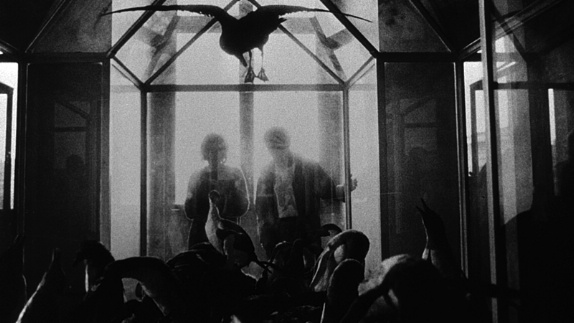
The Man and the Woman in a museum filled with timeless animals, La Jetée (Chris Marker, 1962)
The heirs to Chris Marker’s estate have donated the director’s collection of books, VHS tapes, CD and DVD supports, negatives and photographic prints, press clippings, and other documents to the Cinémathèque française.
Cinémathèque President, Costa-Gavras, signed this agreement on April 23, 2013. The organization will soon begin the process of indexing, cataloging, and digitizing these materials. It will also establish a committee dedicated to promoting their use for non-profit purposes.
The Preservation Department of the Bay Area Video Coalition (BAVC) has launched a Preservation Access program for artists and small cultural organizations. The program is funded by a grant from the National Endowment for the Arts (NEA). BAVC will offer subsidized video and audio preservation services, including preservation planning, collection assessment training, and analog-to-digital preservation transfers. BAVC hopes to advance audiovisual preservation practice and theory based on new and innovative developments in the field.
For more information, contact BAVC’s Preservation Department at (415) 558-2158. Interested individuals and organizations can find more details and access the application here.
On April 24, 2013, House Judiciary Committee Chairman Bob Goodlatte (R-Va.) announced that the Judiciary Committee will conduct a comprehensive review of US copyright law. In his remarks, Goodlatte noted:
“There is little doubt that our copyright system faces new challenges today. The Internet has enabled copyright owners to make available their works to consumers around the world, but has also enabled others to do so without any compensation for copyright owners. Efforts to digitize our history so that all have access to it face questions about copyright ownership by those who are hard, if not impossible, to locate. There are concerns about statutory license and damage mechanisms. Federal judges are forced to make decisions using laws that are difficult to apply today. Even the Copyright Office itself faces challenges in meeting the growing needs of its customers – the American public.
So it is my belief that a wide review of our nation’s copyright laws and related enforcement mechanisms is timely. […] The goal of these hearings will be to determine whether the laws are still working in the digital age.”
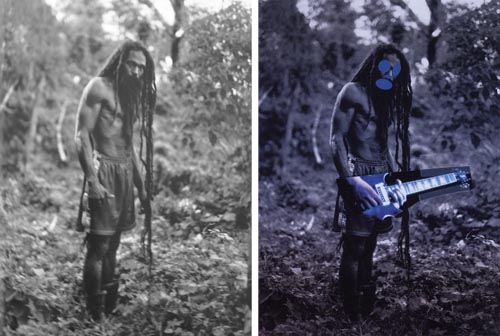
Left: a photo from Patrick Cariou’s “Yes, Rasta”; right: a painting from Richard Prince’s “Canal Zone” series.
On April 25, 2013, a Second Circuit Appeals Court judge ruled in favor of artist Richard Prince in the intellectual property case, Cariou v. Prince. The decision marks an important change in the definition of “fair use.”
The case concerned Prince’s “Canal Zone” series of paintings (2008), which incorporated photographs by French photographer Patrick Cariou for an exhibition at the Gagosian Gallery. In 2009, Cariou brought a copyright infringement suit against Prince, the Gagosian Gallery, Lawrence Gagosian, and catalogue publisher Rizzoli. Cariou argued that the paintings were not covered by fair use protections because they did not comment on the original work. In a 2009 deposition, Prince himself claimed that, “I don’t really have a message.”
The lower court ruled against Prince and ordered the defendants to destroy any remaining copies of the catalogue and unsold paintings that make use of Cariou's images. However, the appeals court overturned this decision and concluded that, “the district court applied the incorrect standard to determine whether Prince's artworks make fair use of Cariou's copyrighted photographs.”
In an email exchange with Art in America, NYU art law professor Amy Adler noted that, “This is a major win for Prince on at least two counts. […] The court decided that artwork does not need to comment on previous work to qualify as fair use, and that Prince's testimony is not the dispositive question in determining whether a work is transformative. Rather the issue is how the work may reasonably be perceived. This is the right standard because it takes into account the underlying public purpose of copyright law, which should not be beholden to statements of individual intent but instead consider the value that all of us gain from the creation of new work.”
This spring, SCMS joined another effort to protect educational fair use and signed onto an amicus brief in the 11th Circuit Court of appeals. Academic publishers Cambridge, Oxford, and Sage all sued Georgia State University over its e-reserve practices, i.e. making teaching materials available through courseware. The university won a big victory in the first round of the case. The district court found that 70 of 75 examples under question were clearly not infringing. The material was used for education and the amounts assigned were small. It was a triumph, but the decision was also overly narrow. Represented by the USC Intellectual Property and Technology Law Clinic, SCMS joined the American Association of University Professors, the Modernist Studies Association, and University of Pennsylvania professors Peter Decherney and Tsitsi Jaji to argue that course reserves can also be "transformative." As many courts, including the Supreme Court, have held, even the use of entire works can be protected by fair use when the purpose of the use is different than the originally intended purpose. When works made by the entertainment industry, for example, are used for teaching, comment, and criticism, they are likely to be fair uses. Further arguments and a decision are expected in the coming months.
Register of Copyrights Calls for Comprehensive Copyright Reform
The American Register of Copyrights, Maria Pallante, has made a series of speeches about the need to modernize Copyright, including offering testimony before Congress. In a June speech to the World Creator’s Summit in Washington, DC, Register Pallante revisited the topic of Copyright reform, and laid out many of the issues that she felt needed to be addressed in any comprehensive reform that may occur. She noted that the last comprehensive reform took place in the 1990s and was twenty years in the making—a delay that cannot occur now, given the number of pressing questions and copyright concerns facing the courts.
More information and a detailed summary of Pallante’s suggestions can be found at Broadcast Law Blog.
The United Arab Emirates National Film Library and Archive (UNFLA) has opened at Zayed University in Abu Dhabi. It is the first of its kind in the Gulf region. The library maintains copies of all films produced in the UAE as well as expatriate films that deal with the UAE. The current catalogue includes over 500 titles, both short and feature-length films. The library is also a repository for related materials, including scripts, production stills, posters, media coverage, and archival materials from the Abu Dhabi Film Festival (ADFF) and the Dubai International Film Festival (DIFF).
The films are part of the Pebble Hill Plantation Film Collection, which includes Georgia's earliest home movies. They were donated to the Brown Archives last year. Plans are being made to screen the films at the Annie Russell Theatre at Rollins College in Winter Park, Florida. A copy of the footage of Russell will be donated to the Rollins archives, supplementing the substantial amount of Russell material they currently preserve.
While conducting research for his book, Hollywood and Hitler: 1933-1939 (New York: Columbia University Press, 2013), Brandeis University Professor Thomas Doherty rediscovered Hitler’s Reign of Terror (Cornelius Vanderbilt, 1934), the first American anti-Nazi film. The film had been unseen for nearly eighty years and previously believed to be lost. With the help of archivists in Belgium, the film was found in cold storage at the Royal Belgian Film Archive.
See The New Yorker for more information on Cornelius Vanderbilt, the production of the film, and its censorship in the United States.
LoC Selects Inaugural Class of National Digital Stewardship Residents
The Library of Congress, in partnership with the Institute of Museum and Library Services, has selected 10 candidates for the inaugural class of the National Digital Stewardship Residency (NDSR) program. The nine-month program offers recent master’s program graduates in specialized fields— library science, information science, museum studies, archival studies and related technology— the opportunity to gain valuable professional experience in digital preservation.
Further details and a complete list of residents is available here.
The Academy of Motion Picture Arts and Sciences (AMPAS), in partnership with New York University and the Orphan Film Symposium, presented a two-day screening series entitled “The Real Indies: A Close Look at Orphan Films” on May 10–11 at the Academy’s Linwood Dunn Theater in Hollywood. The series opened with the West Coast premiere of the restoration of Shirley Clarke’s Portrait of Jason (1967). Other highlights included a screening of the unseen student film Shit (Penelope Spheeris, 1969), a presentation by Rick Prelinger, and screenings of rarely seen works by Saul Bass and Satyajit Ray.
A detailed screening list is available from AMPAS.
Restoration of Richard Wagner Premieres in Baden-Baden
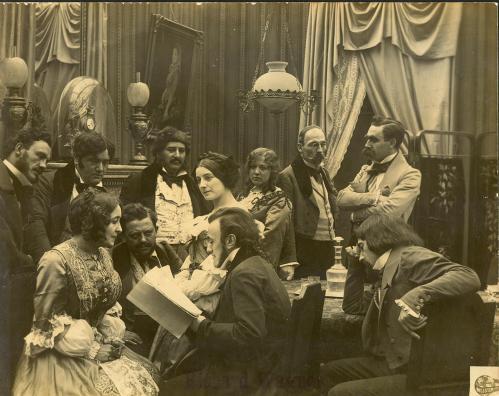
Richard Wagner (Carl Froelich, 1913)
The EYE Film Institute’s 2011 restoration of Richard Wagner (Carl Froelich, 1913) premiered at the Festspielhaus Baden-Baden on May 22. The film pioneer and cinema owner Jean Desmet distributed the film in the Netherlands when it was first released. According to EYE:
“The centenary of the birth of the towering German composer was celebrated worldwide in 1913. That year the German film production company Messter film released a dramatized version of Wagner’s turbulent life, with Giuseppe Becce playing the title role. Becce, who became one of the pillars of the German film industry as a film composer and – later – as musical director of the UFA film studio, also wrote the film score in ‘the style of Wagner’.
[…]
Desmet, too, screened the two-hour film with Becce’s accompanying music. The film, a rather extravagant production in its own time, was widely acclaimed by the public and was shown nationwide, even running in Dutch cinemas until well after World War I. Richard Wagner is regarded as one of the most important and most prestigious of Desmet’s releases.”
Nearly twenty restored films premiered between May 15 and May 26 at the 2013 Cannes Film Festival as part of the Cannes Classics program strand. Titles included La Belle et La Bête (Beauty and the Beast) (Jean Cocteau, 1949), Charulata (Satyajit Ray, 1964), Cleopatra (Joseph Mankiewicz, 1964), Hiroshima Mon Amour (Alain Resnais, 1959), and Sanma no aji (An Autumn Afternoon) (Yasujirô Ozu, 1962).
For the full program and complete restoration details, see Cannes Classics.
The 27th annual Cinema Ritrovato film festival was held from June 29 to July 6 in Bologna, Italy. The program was organized into multiple thematic strands, including (among others):
Recovered and Restored
Silent Hitchcock
Charlie Chaplin at Mutual
One Hundred Years Ago: Glorious 1913
Carbon Lamp Projections, 1903-1907
Preobrazhenskaya and Pravov
Bigger than Life: a Journey through European CinemaScope
Letters from Chris Marker
Emulsion Matters: Orwo and Nová Vlna
The festival also featured two evening performances by the Bologna Teatro Comunale Orchestra. The first performance included two scores conducted by Timothy Brock for Cecil B. DeMille’s Carmen (1915) and Charles Chaplin’s Burlesque on Carmen (1915). The second performance presented the world premiere of a new score composed by Matti Bye and performed by his ensemble to accompany Victor Sjöström’s Berg-ejvind och Hans hustru / The Outlaw and His Wife (1918).
Individual performances of the films have so far been seen in France, New Zealand, Brazil, Ukraine, USA, India, China, Armenia, Sweden and Spain. Further
screenings are planned for the Czech Republic, Mexico, Germany and Australia. The American tour also began this summer,
with nine screenings in New York, Washington, DC, Berkeley, Chicago, Seattle, Houston, Boston, and elsewhere.
The restoration of the "Hitchcock 9" is the largest restoration project ever undertaken by the BFI, which holds some of the most important and earliest surviving copies of the silent Hitchcocks; the restorations also
include materials sourced from other international archives. The nine new BFI restorations include the director’s very first film, The Pleasure Garden (1925), along with The Lodger (1926), Downhill (1927), The Ring (1927), Easy Virtue (1927), Champagne (1928), The Farmer’s Wife (1928), Blackmail (1929), and The Manxman (1929).
Gerhard Lamprecht, Bernd Eichinger at the Deutsche Kinemathek
On June 30, the Deutsche Kinemathek presented the first two of five recently restored silent films by Gerhard Lamprecht: Menschen Untereinander (1926) and Unter der Laterne (1928). The event celebrated the fiftieth anniversary of the Deutsche Kinemathek. Lamprecht was not only a silent film director, but also a collector and one of the organization’s founders. The remaining Lamprecht films will be shown at this year’s Pordenone Silent Film Festival.
In addition, the Kinemathek will exhibit the “Bernd Eichinger Collection” through October 6, 2013. Bernd Eichinger (1949–2011) was a twentieth-century German film producer. The Kinemathek acquired his estate at the end of June 2012. The exhibition divides his cinematic work into four subject areas: “Heroes,” “Germany,” “America,” and “Outsiders.” It also explores Eichinger’s biography, including his childhood in the Bavarian provinces, his first experiments with film, his early activities as a producer with Solaris Film und Fernsehproduktion, and his years as an author and director with Constantin Film.
Library of Congress: Preserving.exe and Mostly Lost
The Library of Congress (LoC) hosted one in its series of small invitational digital content at-risk summits on May 20–21. “Preserving.exe: Toward a National Strategy for Preserving Software” brought together software creators, curators and archivists, and scholars who study software and source code as cultural, historical, and scientific artifacts. The workshop focused on discussions of tractable approaches to the preservation of software and its history, with discussions of substantive, ongoing efforts to preserve and make available historical software applications.
From June 6th to 8th, the LoC held its second film identification workshop, “Mostly Lost: Silent Film Archaeology II.” The goal of the workshop was to utilize the accumulated knowledge of the attendees to identify as much information as possible about unknown, under-identified, or misidentified films. Films from all genres were shown to attendees, who were encouraged to call out the names of actors, locations, car models, production companies, or anything else that they recognized. The workshop was open to all silent film enthusiasts.
Further details and the complete workshop schedule available here.
L’Immagine Ritrovata sponsored a one-day film restoration workshop at the 17th annual Southeast Asia and Pacific Audiovisual Archives Association (SEAPAVAA) conference, held from May 27 to May 30 in Bangkok, Thailand. SEAPAVAA works to promote, preserve, and provide access to the audiovisual heritage of Southeast Asia, Australia, New Zealand, and the Pacific Islands (Micronesia, Melanesia, Polynesia). This year’s conference devoted special attention to debates on world film heritage restoration and audiovisual archives in the digital era.
L’Immagine Ritrovata also announced its “Film Restoration School Asia,” a six-day training course that will provide preservation and restoration training to help safeguard cinematic heritage. Classes will take place at the National Museum of Singapore, in collaboration with the Cineteca di Bologna and Martin Scorsese’s World Cinema Foundation. Applications are available for download here and will be accepted until September 1.
The 14th Annual Northeast Historic Film (NHF) Summer Symposium, Wunderkino, took place July 25–27. For more than a decade, this event has brought together archivists, scholars, artists, and interested members of the public in an intimate setting for three days of viewing and discussing lesser-known, amateur, and found films. The program for this year’s event concentrated on travel. Presentations explored the ways that cinema, from the turn of the twentieth-century, coincided with the advent of mass tourism and transport.
The ninth annual conference of the National Digital Information Infrastructure and Preservation Program and the National Digital Stewardship Alliance, Digital Preservation 2013, was held on July 23–25 in Alexandria, VA. The program provided an opportunity to explore collaborative projects on preserving and accessing digital collections, engage in discussions of current tools and services for the management of digital content, and share current approaches to storage and infrastructure challenges.
The organizers also co-hosted CURATEcamp, an unconference. This event focused on digital stewardship and encouraged discussion about the exhibition of digital collections dealing with narratives, storytelling, and context. Curators, archivists, librarians, scholars, software developers, computer engineers, and others looking to share and refine their ideas about exhibition in the digital age were encouraged to attend and contribute.
The complete schedule, along with video from the presentations, can be found at the Library of Congress.
2013 William O’Farrell Fellowship Awarded to Glasgow Postgrad
Northeast Historic Film (NHF) awarded the 2013 William O’Farrell Fellowship to Graeme Richard Spurr, a postgraduate student in Film and Television Studies at the University of Glasgow. The Fellowship provides a stipend of $1,500 to support research at NHF. Spurr's research project is titled The “Vexed Question of Video”: Charting Transatlantic Amateur Media Practice.
The William O'Farrell Fellowship is awarded to an individual engaged in research toward a publication, production, or presentation based on moving image history and culture. The award honors the legacy of Canadian film archivist William S. O’Farrell, an advocate for amateur and nontheatrical film collections. The 2014 William O’Farrell Fellowship competition will be announced in the fall, with applications accepted through mid-January 2014.
For more information, contact David S. Weiss, NHF Executive Director.
The 2013 International Federation of Film Archives (FIAF) Award was presented to the veteran French filmmaker Agnès Varda. FIAF President Eric Le Roy presented the Award during the “film heritage” lunch co-hosted by the Centre national du cinéma et de l'image animée (CNC) and the Cinémathèque française in Cannes on May 22, 2013. In his presentation to Varda, Le Roy said:
“The relationship between Agnès Varda and cinematheques is a long love story. Cinematheques around the world feel that Agnès Varda has always been on their side, as she has never stopped travelling to present her films in those institutions which preserve, restore and project them. They have always held her as a true friend, sometimes even as a confidante, and as an artist whose work they have always enjoyed exhibiting and programming. The passion with which Agnès Varda has worked over the last twenty years to preserve, restore and disseminate her oeuvre as well as that of Jacques Demy, often in close collaboration with film archives of the FIAF network, remains a model for all present and future filmmakers.”
Helen Forde and Jonathan Rhys-Lewis, Preserving Archives, 2nd Edition
This second edition of Preserving Archives (London: Facets Publishing, 2013) considers the causes of threats to archival material, outlines the preservation options available, and offers flexible solutions applicable in a variety of situations. Authors Helen Forde and Jonathan Rhys-Lewis thoroughly update the text with additional material on digital preservation and environmentally conscious practices.
In The Heretical Archive: Digital Memory at the End of Film (Minneapolis: University of Minnesota Press, 2013), Domietta Torlasco examines the relationship between memory and creation in contemporary artworks that use digital technology while appropriating film materials. Connecting psychoanalysis, phenomenology, and feminist theory in innovative ways, Torlasco argues that these digital films and multimedia installations radically transform our memory of cinema and our understanding of the archive.
Jennifer Peterson, Education in the School of Dreams
In the earliest years of cinema, travelogues were a staple of variety film programs in commercial motion picture theaters. These short films, also known as “scenics,” depicted tourist destinations and exotic landscapes otherwise inaccessible to most viewers. Scenics were so popular that they were briefly touted as the future of film. But despite their pervasiveness during the early twentieth century, travelogues have been overlooked by film historians and critics. In Education in the School of Dreams: Travelogues and Early Non-Fiction Film (Durham: Duke University Press, 2013), Jennifer Lynn Peterson recovers this lost archive. Through innovative readings of travelogues and other nonfiction films exhibited in the United States between 1907 and 1915, she offers fresh insights into the aesthetic and commercial history of early cinema and provides a new perspective on the intersection of American culture, imperialism, and modernity in the nickelodeon era.
Long-lost films by John Ford, Mabel Normand, and Alfred Hitchcock are included in the latest DVD release from the National Film Preservation Foundation (NFPF), Lost and Found: American Treasures from the New Zealand Film Archive. This collection draws from the extraordinary cache of nitrate prints safeguarded in New Zealand for nearly a century and preserved through an international partnership led by the NFPF. Treasures New Zealand not only resurrects lost works by major directors but also presents a fascinating sampling of industrial films, newsreel stories, cartoons, serial episodes, previews, and comedies. The DVD goes on sale in September.
Criterion Releases Film Foundation Restoration of Richard III
The Criterion Collection has released the 4K digital restoration of Richard III (Laurence Olivier, 1955). This project was completed in 2012 under the auspices of the Film Foundation and in collaboration with the Hollywood Foreign Press Association, Janus Films, the British Film Institute (BFI), ITV Studios, MoMA, and Romulus Films.
Richard III was restored under the direction of Sony Pictures Entertainment. The process involved restoring more than one hundred shots. Working from the original Vistavision negative, the film was scanned at Cineric, Inc. in New York and meticulously restored in 4K at Colorworks. For a detailed account of the restoration process, see Creative Cow. See Criterion for further information on the release and a trailer for the restored film.
Martin Scorsese (of Foundation Films) discusses the restoration process below:
A group of American libraries and academic institutions have launched a new centralized research resource, the Digital Public Library of America (DPLA), making millions of resources (books, images, audiovisual resources, etc.) available in digital format. First hatched as an idea at Harvard’s Berkman Center for Internet & Society, the DPLA is now realizing its vision of being “an open, distributed network of comprehensive online resources that draws on the nation’s living heritage from libraries, universities, archives, and museums in order to educate, inform, and empower everyone in the current and future generations.”
As part of the Cinema St Andrews project—an archival project at the University of St Andrews examining all aspects of local cinema history—Drs. Tom Rice and Josh Yumibe have worked in collaboration with a number of archives and institutions to digitize a range of materials, including a complete run of the Colonial Film Unit's in-house journal, Colonial Cinema (1943–1955), key works from the British Documentary Movement, and local materials, such as the Film Programmes (1963–66) from the St Andrews Film Society.
Internet Archive Adds Television News Footage, Early Journal Articles
With one million dollars in support from the John S. and James L. Knight Foundation, the Internet Archive will expand its TV News Search & Borrow service, which now includes 400,000 broadcasts dating back to June 2009. The aim is to help strengthen the work of journalists, scholars, teachers, librarians, civic organizations and others.
The service uses closed captioning to allow users to search, quote, and borrow US TV news programs. The public can use the index of searchable text and short-streamed clips to explore TV news at no charge. The research service does not facilitate downloading, but individuals have the opportunity to view whole programs at the Internet Archive’s library in San Francisco or borrow them on DVD-ROMs.
The Internet Archive also announced the addition of over 450,000 journal articles from the JSTOR Early Journal Content collection. Early Journal Content is a selection of pre-1923 materials from more than 350 journals and includes articles in the arts and humanities, economics and politics, and mathematics and other sciences. This content was digitized by JSTOR and is freely available through jstor.org. It can now also be accessed and downloaded via archive.org.
A collection of Radio Free Europe and Radio Liberty (RFE/RL) publications based on the Polish underground press and a collection of Polish 1980s underground ephemera are now available online in the Open Society Archive (OSA) digital repository.
Both collections belong to the archival legacy of the RFE Polish Underground Publications (PUP) unit, an autonomous section within RFE/RL whose function was to obtain, monitor, and analyze press and other materials circulating without official consent within the vast independent publishing networks in Poland of the 1980s.
The PUP’s principal purpose was to create publications based on the underground press for use by RFE’s Polish broadcast department and other national sections, as well as interested parties in academia and the Western press. The unit’s collection of 1980s ephemera -- stamps, envelopes, postmarks and postcards, banknotes, calendars, photos, fliers and posters, produced by the underground and distributed independently -- illustrates one of the most interesting chapters in the visual history of dissent under Communism.
More details on the collection are available from OSA.
EFG1914 is a digitization project focused on films and non-film material from and related to World War I. It started on February 15, 2012 and will run for two years. More than twenty-five partners, among them twenty European film archives, are working towards digitizing 654 hours of film and ca. 5,600 film-related documents on the theme of the First World War; giving access to the material through the European Film Gateway and Europeana and building a virtual exhibition using selected objects digitized in EFG1914.
EFG1914′s public progress report is now available. The report gives an overview of the goals and results of the first EFG1914 project year and briefly describes the activities in the individual Work Packages.
Two films have recently premiered on the National Film Board of Canada website. The first, Hard Light(Justin Simms, 2011) is available as a digital download. Based on Michael Crummey’s book of the same name, the film transforms the poems and stories from the fishing village of Conception Bay, Newfoundland into a series of visual vignettes.
The second film is Renaud Hallé’s The Clockmakers (2013). This experimental short sweeps viewers into a structure of cogs and wheels where notions of right side up and upside down no longer hold. Dozens of trampolinists evolve in this orderly structure, triggering narrative and musical plots with each jump and rebound.
More works by Hallé available here, here, and here.
This spring, rare color films of several twentieth-century cities circulated widely online, including footage of London from 1926 and a 16mm Kodachrome tour of New York City, shot during the summer of 1939. The London footage was excerpted from the Claude Friese-Greene’s documentary, The Open Road, and uploaded to YouTube by the British Film Institute (BFI). The scenes of New York City were filmed by Jean Vivier—a French tourist who sailed to the city from Marseille—and made available by the Romano Archives.
IBM Introduces World’s Smallest Movie and Atomic-Scale Memory
IBM researchers recently released A Boy and His Atom: The World’s Smallest Movie, a stop-motion animation made by using a scanning tunneling microscope (STM). The STM allowed researchers to move thousands of carbon monoxide molecules (two atoms stacked on top of each other), one at a time, frame by frame. The movie can be seen with the naked eye only when magnified one hundred million times.
The nanotechnology used to make the film has much broader implications in the field of data storage. It takes roughly one million atoms to store a single bit of data on a computer or electronic device. A bit is the basic unit of information in computing. Recently, IBM researchers announced that they now can store that same bit of information in just twelve atoms.
Learn more about how the film was made here and here. Learn more about atomic-scale magnetic memory here.
After spending more than £98.4m on its Digital Media Initiative (DMI), the BBC has decided to close the project to avoid “throwing good money after bad.” The DMI was designed to eliminate video tapes and create a kind of internal YouTube of archival content that staff could access, upload, edit, and air from their computers. From BBC director general Tony Hall:
“The DMI project has wasted a huge amount of licence fee payers’ money […] I have serious concerns about how we managed this project and the review that has been set up is designed to find out what went wrong and what lessons can be learned. Ambitious technology projects like this always carry a risk of failure, it does not mean we should not attempt them but we have a responsibility to keep them under much greater control than we did here.”
As Kodak prepares to emerge from bankruptcy this summer or fall, the company’s financial prospects are unclear. In May, Rochester’s Democrat and Chronicle reported that the company had “slashed massive amounts from its monthly expenses” and was showing signs of financial health. The company has licensed or sold many of its unprofitable sectors and transitioned away from the consumer market to focus on commercial sales. In early June, for example, Kodak reached an agreement with 20th Century Fox to supply motion picture film to its movie and television studios.
According to the New York Times, however, “Some skeptics sounded warnings about Kodak’s outlook, noting that certain commercial businesses that the company is banking on are fiercely competitive and that Kodak’s own projections show steep declines in growth in other business lines.” The company is also struggling with the financial repercussions of environmental clean up.
Architect William McDonough will be the first living archive at Stanford University. This means that Mr. McDonough, a leader in sustainable development, has started filming all of his meetings and recording all of his phone conversations. He will send them in something close to real time to Stanford, which will be making much of the material immediately accessible on the Internet.
Jeff Ubois, the founder of the Personal Digital Archiving conference—now held under the auspices of the Library of Congress—said he hadn’t heard of anything exactly like what Stanford was doing. Gordon Bell of Microsoft Research won wide notice a couple of years ago for his “life-logging,” which involved putting everything he had accumulated, written, photographed, presented and owns (like CDs) into what he called his “local cyberspace.” That, however, was a personal initiative, not a collaboration with an institution.
“I think this will become a common practice,” Mr. Ubois said. “Now that we know technologies go obsolete, it will be even more important to archive things contemporaneously.”
“Archival News” reports recent news highlights from the media archive community for the Cinema Journal readership. Some information in this column comes courtesy of the Association of Moving Image Archivists (AMIA) listserv, along with institutional newsletters, websites, and press releases. This column is updated quarterly. Contributions to this column are welcomed. Information should be sent to Katherine Groo, Lecturer, Film and Visual Culture, School of Language and Literature, University of Aberdeen, Taylor Bldg. A, Aberdeen AB24 3UB, Scotland; phone +44 (0)1224-701590; email: [email protected].

 The Man and the Woman in a museum filled with timeless animals, La Jetée (Chris Marker, 1962)
 Left: a photo from Patrick Cariou’s “Yes, Rasta”; right: a painting from Richard Prince’s “Canal Zone” series.
 Richard Wagner (Carl Froelich, 1913)