|
Posted By Chuck Kleinhans,
Sunday, March 10, 2013
|
VIDEO PORN PANEL
"Porn Comes Home: Sex Media and the Creation of Home
Entertainment” was a great panel in which original historical research
illuminated the emergence of video porn in the past 40 years. The temporally overlapping papers gave a
sense of rich density to the subject at hand.
Joshua Kitching discussed the legacy of the "video underground” in the
1969-76 period where the existence of the Sony Portapak allowed the
counterculture vanguard to document and exploit sexual themes and
representations in the new technology.
Combining carnal images with McLuhanesque notions about the medium, the
work ranged from obsessive autobiographical diaristic work (put your life on
tape as with Carel & Ferd), to
artist video manipulation of naked bodies (Sex
Machine by Wood and Steina Vasulka).
Next, Peter Alilunas discussed the "prehistory” of home
video using the underground economy of about 30 Los Angeles motels which
suddenly started offering room rentals with hard core porn (delivered via
internal cable from the main office using Sony U-matic format, before Beta and
VHS cassettes) that you could see privately, as opposed to the usual theatrical
exhibition. This immediately raised
issues of the law in terms of porn, and also copyright, and (just discovered) possibilities
of a rental market for films. But it also lays out an alternative to the usual
history of home video in which the "illicit” history has been repressed or
overlooked in the "official” or above-ground telling of the story. [Full disclosure: I’m an outside member of
his dissertation committee, and just gave him comments on three terrific
chapters of the project.]
Then Andrew Owen discussed "Gay, Straight, and Everything
In-Between: Fluid Porn Desire in Playgirl,”
looking at the nude presence of men as centerfolds in the ostensibly
female-readership magazine. As was
widely known and discussed from its own time on, the magazine also attracted a
gay male readership. Owen was able to
place this in several useful institutional contexts: the opening up of sexual
discussion and imagery in a variety of women-oriented publications of the time,
the careful star/celebrity management of closeted and coming our narratives,
and the production of gay-for-pay stardom later in video porn history. (FD: I’m
also on Andy’s dissertation committee.)
Eric Schaefer was the respondent, and provided a welcome and
longer frame for the issues by discussing his own view of the problem of doing
historiographical research in an area of "distasteful history.” He discussed the difficulty of doing primary
research (or even secondary research) in this area and how assembling a
critical mass of scholarship out of the erratic and available documents lets us
then see connections or traces which allows for a more thorough analysis.
This panel was another case of something I was seeing
repeatedly at the conference. The
remarkable assemblage of new archival materials over the past two or three
decades has allowed young scholars to do vital new research. But their approach, by necessity, begins with
texts and fragments that don’t always or yet reveal other networks,
backgrounds, connections (sometimes personal, sometimes institutional), and so
forth. For example, Josh showed an ad
for "Carel and Ferd,” an early 70s shot-on-portapak diary video of the personal
life (including sex life) of a man and a woman who had been involved in the San
Francisco porn business at the time.
What he didn’t (yet) know [I’m revealing it now] is that Carel Rowe went on
(shortly) to grad school and her dissertation (at Northwestern, 1977) was
published as a key book on early New American Cinema, The Baudelairean cinema : a trend within the American
avant-garde (1982), covering Kenneth Anger
and others. (She also produced, wrote,
and directed videos including: Paradise
denied: a covert report on Turkish North Cyprus (2003). Again FD: I discuss her career in a different
direction here: http://www.ejumpcut.org/archive/jc53.2011/kleinhans-creatIndus/index.html
But often in the whole SCMS conference, I witnessed direct
encounters, across and within generations, of productive and fluid
connections. Witness the P6 panel with
Dorit Naaman commenting on Sarah Barkin’s essay on Israeli and Palestinian
First Person Documentaries. As some of
the conference tweets attested: people were meeting their footnotes,
encountering the actual bodies of their comp and qual exams, and managing "celebrity
sightings.” Yes indeed: academic celebrities:
"They’re just like US!”
Tags:
Andrew Owen
Carel Rowe
celerity sightings
Dorit Naaman
eric Schaefer
Josh kitching
Peter Alilunas
Sarah Barkin
they're just like us!
video porn panel
Permalink
| Comments (0)
|
|
|
Posted By Chuck Kleinhans,
Saturday, March 9, 2013
|
THURSDAY
Chicago
OK, the spendy (Oregon localism for costly, pricey)
breakfast buffet at the Drake: $25 is definitely overpriced for someone who
thinks a value breakfast is a coupon that gets you two of the new Breakfast
Steak and Egg Burritos at McDonald’s for
$1.79. [details on my friends and family blog: Chuck & Chow, http://chuckandchow.tumblr.com
] But sometimes you
need a big breakfast to power through the day.
I’m torn between several panels at t he same time. Really would have liked to have attended one
on Avant Garde and Advertising: Experimental Film culture in the Interwar
Years, but decide on Where the Minor was Mainstream: The Sponsored, Amateur,
Educational, and Experimental Cinemas of Chicago. The presentations are based out of new
archival research, and that’s a Big Story at this conference. So much great work is being done with the
work of the past few decades in assembling new archival collections. These are from the Chicago Film Archives
(more accurately Midwest). Andy Uhrich
discusses "Shakespeare as Home Movies, Chicago as the Globe: David Bradley’s
Macbeth (1947) and Julius Caesar (1950),” detailing an attempt to make prestige
art films by an economically privileged North Shore ambitious amateur. The Julius Caesar starred a very young
Charleton Heston and used Neoclasssical Chicago architecture as scenes for a
16mm film with aspirations to enter the big time market (ending up in the
education market). Bradley even screened
films regularly in his spacious home, advertising in the daily press. This was
an example of a beautifully detailed history.
Charles Tepperman followed with "Behind the Scenes at
Central Cinematographers: A brief History of Amateur Movie Clubs in Chicago,”
which spelled out the long standing furry of cinephile movie showing and making
in the Windy City. The prestige Chicago
Movie Club was a place for very rich people to amuse themselves but opened up a
space for another kind of cinema. The
Metro Movie Club supplied a more democratic alternative, and Central
Cinematographers was a more specialized grop that made 4-10 minute movies
rotating positions for the group projects.
All of these institutions established networks and gave people skills,
experiences, and club fun (and especially opened up some space for women to be
active.)
Michelle Peutz discussed the 1970s-80s experimental and
feminist work of JoAnn Elam who had one foot in political activism and one in
the avant garde film community and who screened both in her home as as one of
the founders of Chicago Filmmakers (which still continues today). Michelle has been the key archivist at
Chicago Film Archives for the Elam collection and in talking about it combines
an exploratory openness to this under recognized work with a rigorous
historical view. [Full disclosure: Michelle and I have worked together on
getting the late filmmaker’s materials organized for the CFA.}
Judy Hoffman [full disclosure: old friend and comrade in
arms in left media work] provided a terrific response: filling in lots of other
examples and reminding everyone present of all the other networks and organizations
that need to be accounted for. Work
around other neighborhoods, the power of the craft unions IATSE’s
cinematographer and projectionist unions (nepotism and racist/sexist practices),
the corruption of the Daley political system (repeat) as well as the Mafia, the
connection of art house and art film and
softcore porn locally, the grassroots alternatives such as Facets Multimedia
and Chicago Filmmakers, production projects such as Kartemquin. Judy reminded everyone that while the
mainstream presented itself as "professional,” it was the amateurs and
alternatives that lived and enacted a "utopian moment”: progressives and
lefties were part of a network that created its own audiences, distribution and exhibition spaces, training
and experience. Clearly, the oral
history and memory of participants in these past moments are slipping by, but
help us all understand the basis of what happened.
All of this was part of a fluidity of categories that
participants remember and took for granted.
It was the water they swam in: today’s younger historians in going back
are looking at the water (sometimes murky) and reconstructing a complex past. I came away from this very charged up for my
own paper the next day, but also respecting these critics and investigators who
are giving us such a better sense of the past, including folks like Amy Beste
whose recent dissertation discussed the influence of the Bauhaus-in-Chicago
School of Design, Encyclopedia Britannica Films, and local
industrial/advertising houses in the post-war era, and Jackie Stewart’s South
Side Home Movie project. My take
away: this is great foundational work
and matches a whole new wave of looking at institutions (think Scott Macdonald’s
work on experimental film exhibitors, distributors, and so forth and David James’
work on non-Hollywood Los Angeles cinema), and alternatives to the Hollywood
feature model of understanding cinema.
Tags:
Chicago
downtown prices
Elam
Hoffman
Peutz
SCMS
Tepperman
Urich
Permalink
| Comments (0)
|
|
|
Posted By Chuck Kleinhans,
Thursday, March 7, 2013
|
Generations
I’ve been having lots of thoughts about generations at the
conference. Maybe this comes with being
an old geezer. Easier to think of the distant past and with nostalgia than
remember the film title or name of someone I recognize (or fail to recognize)…call
it the Emeritus Effect.
Old friend Patricia Erens told me that she thought that
Maureen Turim and Scott Nygren’s child might be presenting, and when I saw
Maureen, she said yes, her daughter Mika, who is now a grad student, was giving
a paper Sunday morning on Yiddish cinema.
Wow, I thought, remembering that I first met Maureen when she was an
undergrad back in the 70s.
At breakfast with and Julia Lesage and Jyotika Virdi, we
talked about how two young scholars of South Asian cinema told Jyotika after
her presentation that her book The
Cinematic ImagiNation: Indian Popular Films as Social History, was
foundational to their work. "They called
me Professor!” she said, and I said, "well those are your intellectual
children, and Julia’s grandchildren.” (Since Julia directed Jyotika’s
dissertation.)
Last night Julia and I had drinks with our niece and nephew,
Leigh Duck, who is now at Ole Miss, and giving a paper the same time as mine on
Friday….darn! Her husband, Michael
Lesage filled us in on his side of the far flung family. We hadn’t seen them for a decade. (Sudden illness kept us from attending a key
wedding.) So it was great to catch up, fill in, and appreciate.
Had lunch time with Barry Grant, who’s busy as ever editing
books and collections, and in the middle of republishing the late Robin Wood’s
work, which brought on more nostalgia for Robin’s feisty and smart and
(sometimes pure ornery) temper.
I remember trying to attend my first SCMS meeting in the
mid-70s. It was at Northwestern, and I
was living in Chicago, driving a school bus for a living and starting up JUMP
CUT. I showed up, and was told I
couldn’t attend because you had to pay a faculty membership and faculty
conference fee, and since I had my PhD, I couldn’t have the student rate. I pointed out that I wasn’t faculty. I knew a few of the people attending and
finally they said I could stay for the day since I was there, but I couldn’t
attend the next day. I complained, and
later Calvin Prylock tjold me privately that the progressives were trying to
change the situation. A few years
earlier they had changed from the Society of Cinematologists, and being a group
you could not join: you had to be considered worthy by a member, and then
nominated for membership! Old Boys Club
indeed!
That meeting had two concurrent sessions: the Film
Historians on one floor and everything else below. Cinema
Journal at that point only accepted article on Film History in an attempt
to seem worthy of being in the academy.
Well, times have changed.
This post has not been tagged.
Permalink
| Comments (0)
|
|
|
Posted By Chuck Kleinhans,
Thursday, March 7, 2013
|
Wednesday
Session B16, Violent Girls and Tough Women. This interesting panel pushed some new topics
to the front of the Warrior Woman discussion that’s been going on for some
time.
Cristina Stasia discussed "girls in action” specifically
looking at young females in HIT GIRL, HANNA, and HUNGER
GAMES. In contrast to the hyper
sexualization of Hollywood’s action females, they exhibit skill and
accomplishment without the conventional undressing, skimpy costumes, and sexual
seduction of the adult actors. The paper
raised good questions about the difference, and validated the active and
skilled child, providing some clues for the popularity of these characters and
themes.
Ilene Goldman surveyed the Snow White story from its folklore
history and the Grimm Brothers versions (they revised it several times) to the
variety of screen versions. She
acknowledged the now classic interpretation of the story (studied by Jack
Zipes) as being about the mirror and the stepmother, but pointed out that Snow
is the figure in the story who sees the whole world, sees beyond vanity, and
thus acts within the world and with sympathy and understanding. Elaborating on Snow White and the Huntsman, she pointed out how the star system
has evolved the many variants of the story.
Ian Murphy offered an intriguing discussion of Jennifer
Jason Leigh’s performance in Last Exit to Brooklyn in terms of using an
excessive femininity to cover very masculine actions, including the "Method
Acting slouch” often seen in images of Brando and Dean. The analysis discussed a kind of sliding or
crossover from masculinity to femininity.
The study further complicated the "tough girl” image oscillating between
victimizer and victim.
Robin Means Coleman extended her recently published book, Horror Noire:
Blacks in American Horror Films from the 1890s to Present, to contrast
the (usually white) Final Girl in horror with the "enduring black woman,”
pointing out that centering on black women often revealed them using sex as a
weapon, and taking on structures of oppression, not just the Monster. Considering the difference opens up new ways
of understanding films and also racial images, including racist depictions of
Oprah Winfrey and Michelle Obama.
The panel showed the power of comparison and contrast for
elaborating our analysis, and I immediately wanted to read the papers to follow
them in depth. I didn’t get to stay for
the next panel, Rebooting the Fairy Tale,
(C16) which looked to continue the discussion with papers on Snow White,
Hanna, and Grimm. [Full disclosure:
Ilene is a friend and colleague, and I’d worked with Ian as an editor of an
article in JUMP CUT, but this was our first in person meeting.]
A workshop on the American Smart Film began with Thomas
Dorey briefly recapping Jeffrey Sconce’s influential 2002 essay on the Smart
Film and discussing how the term has been variously intetpreted and
misused. Covering a group of films that
go beyond being just a genre or cycle, the works are marked by irony and produce
a kind of dark comedy in a blank style often centering on white middle class
families/people and their disfunctions.
They critique taste and
consumerism and the limits of identity.
Crippled people inhabit a world of neurotic self-interest.
Murray Pomerance furthered the discussion by arguing that
Purple Rose of Cairo might be a landmark here, a film in which Characters and
actors mingle. He then pursued this with
the example of Jesse Eisenberg who continuously practices a star image of
hiding what he thinks or who he is by talking too much, too rapidly, but saying
nothing, thus protecting his self identity.
Murray used the Canadian slang "deeking” meaning in ice hockey fooling
your opponent by looking one way and then moving the other, to capture the
device. "Smart” in this context meant
being totally aware of the voracious nature of contemporary media and wanting
to evade it.
Claire Perkins, who has published a book on American Smart
Film discussed the masculinist and smart ass style of the Smart Film which
seems to exclude females. But she saw
potential in the characteristic "running in place” depiction as possibly
holding out a narrative of a character in a state of flux. And the reduced frame let the films function
as fables, implying an ethical project.
The excessive narcissism functions as a scathing critique. She posited Tamara Jenkins and Miranda July
as directors whose films project a desire for transformation out of the "Smart”
world and show care for others.
Jeff Sconce then spoke about how his initial essay came from
anger at a critical crowd that was trashing films he saw as actually speaking
to while critiquing his own identity (white, middle class, male). Rather than pure cynicism and irony, he
thought the films often spoke to the human situation within a constricted framework. Using Happiness
as a center point, he argued that it was being misread if the critic didn’t
see the failing vulnerability, the compromised idealism in the characters. He added that perhaps Mumblecore films are a
continuation. In some very provocative
remarks, he pointed out that "tone’ is a particularly understudied and under
examined mater in the film-audience relationship, but key to the problem that
Smart Film poses. Smart Film tends to
divide its audience, making some viewers angry and other viewers loyal. How one interprets tone is crucial here (and I’d
add, this might help us rethink Sirk, for example).
I had to leave as the discussion was beginning in earnest,
but clearly the room was filled with people who were thinking about these
issues. Is there a balance or return to
sincerity in the narratives to balance the cruel cynicism? Sconce pointed to the Lena Dunham situation,
with some people vociferously denouncing the characters in Girls as entitled narcissists.
But Jeff pointed out that as much as the characters embody attitudes and
ideology we might critique, the work itself criticizes a society that puts this
situation in place. I thought of Enlightened as another (distinctly LA or
West Coast) example, and wondered how to fit in the Netflix House of Cards serial. [Full disclosure: I’ve known Murray for
years, particularly as an editor of some of my writing, and Jeff was my
Northwestern colleague for years. If you
don’t know it, check out his great blog:
http://www.ludicdespair.blogspot.com. (quick start on this topic: Belated
Thoughts on Themed Dining in Todd Solondz's "Life During Wartime"
and Baffled by
Bellflower]
Tags:
cynical irony
fighting females
girls
Smart Film
snark
warrior women
Permalink
| Comments (0)
|
|
|
Posted By Chuck Kleinhans,
Wednesday, March 6, 2013
|
Someting weird here. Tonight (Wed.) there's supposed to be a panel presentation on Chicago social documentary and the next stage. the SCMS program lists it as 8-9 pm But the Museum of Contemporary Art (which is where it is taking place) says it is 6-7 pm. And there are two different panels, and a q and a to follow. Great panel (full disclosure: friends from back in the day, and even today) Michelle Citron, Ruby Rich, Gordon Quinn of Kartemquin. Plus Alan Siegel and Steve James. I think Brendan Kredell is organizing this, but I can't find his email address....if you can, can you ask him to clarify it.
Tags:
documentary
help
kredell
schedule
Permalink
| Comments (0)
|
|
|
Posted By Chuck Kleinhans,
Wednesday, March 6, 2013
|
Missed my connecting flight in San Francisco but United put me on the next flight to Chicago, which was also delayed a bit, but smooth flight and only three hours late. 1500 flights have been cancelled at O'Hare, so I felt lucky to get here in reasonable time. Checking in late at The Drake, the guy said there had already been lots of cancellations. For just showing up, got a room upgrade. Sweet. Late supper in the Drake's bar: excellent lamb sandwich, house sald on the side also ample and excellent. Downtown prices for a beer. time to sleep.
Tags:
cancellations
snow
tues night
Permalink
| Comments (0)
|
|
|
Posted By Chuck Kleinhans,
Sunday, March 3, 2013
|
SCMS Chicago 2013: a homecoming
I love Chicago, and I’m glad to be back! I was born and raised in the city, and I
returned in 1973 and stayed for 35 years before riding off into the sunset and
Eugene, Oregon.
Some quick essentials for those who don’t know the city:
• if you don’t like the weather, wait for half an hour.
• wear layers; Chicagoans are notoriously comfortable not
fashionable
• but people do appreciate seeing others who are
fashionable: enjoy the stares (and the looks of pity when your feet get wet
because you didn’t wear sensible boots)
• walk or run by the Lake, feel the space open up
• Parking is outrageous: expensive on and off the
street. Unless you are a local, you are
probably better off using public transportation. If it snows (yes, it may) or rains (almost
certain), good luck finding a taxi cab.
• it’s a city of neighborhoods, and all the really good
restaurants (food and value) are hidden there, and no, we won’t tell you our
favorites
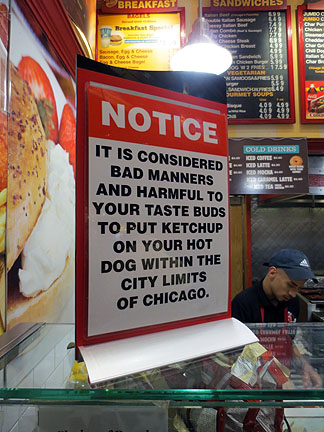
• "locavore” in Chicago means "encased meats”: hot dogs,
Polish sausage, Italian sausage, and also Italian beef (get the combo, meaning
they add a sausage, with sweet peppers, dipped) and gyros on pita bread. Vegans can do falafel on pita. It is against the law to put catsup on any of
these items.
You shouldn’t conference all the time: set your restart
button and get out for half a day. My faves:
The Art Institute of
Chicago:
A great new exhibition: Chicago and Migration, 1910-1950
covering the Great Migration from the Deep South, and Europe, Latin America and
Asia.
And, AIC’s classic collections: French Impressionists, Japanese Screens and
Woodblock prints, photography, etc. And,
for a great change of pace and offbeat experience (great for kids): the Thorne
Miniatures, the Rubloff Paperweights.
The Chicago
Underground Film Festival
In its 20th year, an astonishingly rich program
running through the weekend at the Logan Theatre, Logan Square (an old
commercial theatre plexed with two screening rooms). Chicago premiere of Sandra Gibson and Luis
Recoder's projection performance UNTITLED (with sound artist Olivia Block), opens
the festival on Wednesday, 3/6, at 8:00 pm. Easy to get to with an "el” stop right
there. http://cuff.org/2013-fest/2013-full-program/
The Seminary Co-op
Bookstore
(University of Chicago area:
5751 S. Woodlawn).
Simply the best academic bookstore between the two
coasts. 150,000 humanities and social
science titles in stock. And now in new
quarters after 50 years in a basement.
http://www.semcoop.com
Chicago
Architecture Foundation tours
Great tours, both DIY and guided of different lengths and
interests.
http://www.architecture.org/tours
Especially for kids:
the Field Museum (Natural History) and next door campuses with a Planetarium
and Aquarium. Further adventures:
Lincoln Park Zoo, Museum of Science and Industry.
Attached Thumbnails:
This post has not been tagged.
Permalink
| Comments (0)
|
|

 Group Home
 Blog Home
 Group Blogs
 RSS