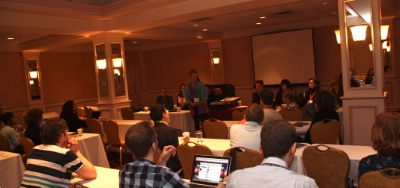
As the "New Members Orientation” session began yesterday
morning, a good distinction was made: while we generally refer to "SCMS” as the
conference itself (given that we are as "SCMS 2012,” for example), technically
there remains a larger entity to which the term refers.
It’s easy sometimes to forget this: while those issues of
Cinema Journal show up on our doorsteps four times a year, the day-to-day
engagement with SCMS is limited for me, which makes the term far more
associated with this conference than with any broader entity.
This session seemed designed to reinforce the existence of
the society at large, focusing less on questions and more on the "benefits of
membership,” which I found interesting if also somewhat disappointing. Of
course, I am not myself a "new” member having joined in the run-up to last
year’s conference in New Orleans, but I nonetheless felt there was something
missing from the meeting that would allow it to best serve as an orientation:
dialogue.
To be fair, there was a Q&A which ended the session, but
by that point it had been roughly ninety minutes of fire alarm-interrupted
panelists speaking about different areas, and I think everyone was thinking
about the next panel (or, just as likely, lunch). They spoke well, and I am
sure the people in the audience learned something given that I learned many
things I didn’t know. However, to me it seems important to start with questions and work from there: the formal presentation
style ensures that everything gets discussed, but working from audience
concerns and questions might be able to activate a more focused conversation
and better engage with specific anxieties that come with the conference.
To be fair, there were very few questions during that
Q&A, which might suggest that the presentations answered any questions they
might have had. However, and this is just speculation designed to perhaps help
improve these meetings in the future, it’s also possible that they felt they
had been given so much information that there wasn’t room (or time) for more
questions.
The next event I attended yesterday was a workshop on Teaching
the Negative Representation (which Chris Becker will write about as part of her
post about yesterday’s events), and it made me wish that the New Members
Orientation was treated more like a workshop than as a formal presentation. It
would be the first workshop that many members might attend, and it could allow
them to acclimate to the society within the more casual dynamics of a group of
people in a room talking about something important rather than two groups of
people (speakers and listeners) laying out the society’s bureaucratic functions.
I fear this may sound too critical of the people who were
part of the orientation, as they were well-informed and passionate, and I doubt
anyone at the orientation session would say that it was a waste of time.
Indeed, I’d even suggest that others who didn’t make it to yesterday’s session
should consider heading to today’s session (2:15pm in Statler) if they want to learn more about how
Cinema Journal works or what goes on
within the Conference Selection committee. However, I feel like it could be
more helpful if the balance was shifted from one end of the long table at the
front of the room to the other – when I dropped in on the TV Studies Special
Interest Group meeting later in the evening, the conversation dotted through
the room at a quick pace, the kind of dialogue that pushed us towards a better
understanding of how we operate. While that sort of productive anarchy may not
work at an orientation, it’s still something I would strive for.
I left the orientation with a better understanding of the
intricacies of SCMS, and a good sense of the future vision of Cinema Journal under incoming editor
Will Brooker, who spoke about plans to create online relationships between CJ and other online publications like
Antenna and In Media Res. I learned about the different caucuses, and I heard
about the evolving website, and I generally know more about SCMS than I did
before I attended the meeting.
However, I do wonder if "information” is the ideal goal of
an orientation setting – this is likely just a matter of opinion, but the best
orientation strategy is a more casual environment. At various points, a few
panelists shared stories of their first SMCS, and I wished that we had heard
similar "origin stories” from each panelist. Instead of talking about the
benefits of membership in a structured environment, show them the value of
being a part of the SCMS community by inviting them into a less formal conversation
between the people who make it run about what made them want to run it.
I am only speaking for myself, however, and I’d welcome
anyone else who attended the session as a real "new” member to let me know what
you thought. You can leave a comment below, or you can send me an email at [email protected] - would love to hear from
you and pass any feedback on to others for future sessions.

 Group Home
 Blog Home
 Group Blogs