  
|
Posted By Myles A. McNutt,
Friday, March 23, 2012
Updated: Friday, March 23, 2012
|
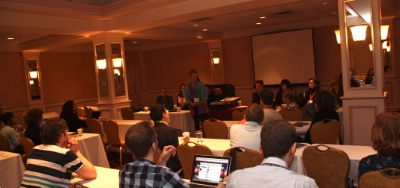
As the "New Members Orientation” session began yesterday
morning, a good distinction was made: while we generally refer to "SCMS” as the
conference itself (given that we are as "SCMS 2012,” for example), technically
there remains a larger entity to which the term refers.
It’s easy sometimes to forget this: while those issues of
Cinema Journal show up on our doorsteps four times a year, the day-to-day
engagement with SCMS is limited for me, which makes the term far more
associated with this conference than with any broader entity.
This session seemed designed to reinforce the existence of
the society at large, focusing less on questions and more on the "benefits of
membership,” which I found interesting if also somewhat disappointing. Of
course, I am not myself a "new” member having joined in the run-up to last
year’s conference in New Orleans, but I nonetheless felt there was something
missing from the meeting that would allow it to best serve as an orientation:
dialogue.
To be fair, there was a Q&A which ended the session, but
by that point it had been roughly ninety minutes of fire alarm-interrupted
panelists speaking about different areas, and I think everyone was thinking
about the next panel (or, just as likely, lunch). They spoke well, and I am
sure the people in the audience learned something given that I learned many
things I didn’t know. However, to me it seems important to start with questions and work from there: the formal presentation
style ensures that everything gets discussed, but working from audience
concerns and questions might be able to activate a more focused conversation
and better engage with specific anxieties that come with the conference.
To be fair, there were very few questions during that
Q&A, which might suggest that the presentations answered any questions they
might have had. However, and this is just speculation designed to perhaps help
improve these meetings in the future, it’s also possible that they felt they
had been given so much information that there wasn’t room (or time) for more
questions.
The next event I attended yesterday was a workshop on Teaching
the Negative Representation (which Chris Becker will write about as part of her
post about yesterday’s events), and it made me wish that the New Members
Orientation was treated more like a workshop than as a formal presentation. It
would be the first workshop that many members might attend, and it could allow
them to acclimate to the society within the more casual dynamics of a group of
people in a room talking about something important rather than two groups of
people (speakers and listeners) laying out the society’s bureaucratic functions.
I fear this may sound too critical of the people who were
part of the orientation, as they were well-informed and passionate, and I doubt
anyone at the orientation session would say that it was a waste of time.
Indeed, I’d even suggest that others who didn’t make it to yesterday’s session
should consider heading to today’s session (2:15pm in Statler) if they want to learn more about how
Cinema Journal works or what goes on
within the Conference Selection committee. However, I feel like it could be
more helpful if the balance was shifted from one end of the long table at the
front of the room to the other – when I dropped in on the TV Studies Special
Interest Group meeting later in the evening, the conversation dotted through
the room at a quick pace, the kind of dialogue that pushed us towards a better
understanding of how we operate. While that sort of productive anarchy may not
work at an orientation, it’s still something I would strive for.
I left the orientation with a better understanding of the
intricacies of SCMS, and a good sense of the future vision of Cinema Journal under incoming editor
Will Brooker, who spoke about plans to create online relationships between CJ and other online publications like
Antenna and In Media Res. I learned about the different caucuses, and I heard
about the evolving website, and I generally know more about SCMS than I did
before I attended the meeting.
However, I do wonder if "information” is the ideal goal of
an orientation setting – this is likely just a matter of opinion, but the best
orientation strategy is a more casual environment. At various points, a few
panelists shared stories of their first SMCS, and I wished that we had heard
similar "origin stories” from each panelist. Instead of talking about the
benefits of membership in a structured environment, show them the value of
being a part of the SCMS community by inviting them into a less formal conversation
between the people who make it run about what made them want to run it.
I am only speaking for myself, however, and I’d welcome
anyone else who attended the session as a real "new” member to let me know what
you thought. You can leave a comment below, or you can send me an email at [email protected] - would love to hear from
you and pass any feedback on to others for future sessions.
Tags:
New Members
New Orientation
SCMS
Permalink
| Comments (1)
|
|
|
Posted By Myles A. McNutt,
Thursday, March 22, 2012
|
What do we learn at
SCMS?
First of all, we learn that the complete lack of any sort of
lunch break means your stomach winning a battle with your brain over those 12pm
panels you were considering attending.
We also learn that when wireless internet passwords are
spread like a state secret, it gives you good reason to enjoy some pre-panel
small talk with those who have been given the responsibility of those
clandestine characters.
However, we also learn how
to "SCMS” (in this case using SCMS as a verb, because I’ve long ago given
up on respecting the boundaries of the English language). While I always find
that I learn a lot intellectually at the panels and workshops I attend at
conferences, the main takeaway often ends up being about the actual process of
attending, presenting at, and generally engaging with conferences like this
one.
This is especially true on the days when I am myself
presenting, as I’m constantly thinking about my own paper and what I could do
to improve on it. With a 4pm slot yesterday, it was a real challenge to keep my
brain from obsessing over the paper to come, and I ended the day feeling like I
had accomplished nothing but self-torture. In the end, as is inevitably the
case, I wasn’t entirely happy with my presentation, even though my fellow
panelists gave provocative and important papers and we had an incredibly
gracious audience who dealt with a bit of time overrun and stuck around for
some additional conversation. The day I present at SCMS is always a day I leave
looking forward to the next time I present at SCMS, where I will hopefully fix
those things I felt could be better (just to, of course, find new things to
have problems with next time around).
However, while this mindset can be a bit soul-sucking, I do
think it forces you to think about the little things. I greatly enjoyed the two
full panels I was able to attend in addition to my own today in terms of the
papers delivered and the conversations we had, but there’s also something to be
said for how those conversations were shaped and formed, which is where my
takeaways for the day lie. I do not want to suggest I hold any grand knowledge
about a conference I have only attended twice, but I do want to share at least
a few of the observations I took from day one.
In the case of A5’s "The Television Procedural,” the only
television-focused panel in the timeslot and thus the immediate magnet for a
television scholar (especially given my own interest in genre), I saw the
benefit of a three-person panel. Not only did it allow more time for conversation,
but it also framed that conversation more broadly, giving us time to delve into
each paper (or explore connections between papers) more readily. Claudia
Calhoun was forced to limit her presentation on "Civic Architecture and Civic
Instruction in Postwar Police Procedurals” to the Civic Instruction side of the
equation for time purposes, but the additional time in the comments meant I
could push her to discuss the architecture, nudging the panel at large
(including both Jonathan Nichols-Pethick’s work on the procedural and network
branding logic and Kathryn VanArendonk’s
take on Bones and the Victorian
procedural) to consider similar issues of space and place (as was my master
plan, given its connection to my own research). The room was small, the group
intimate, but it felt like more than just a Q&A emerged: it was a conversation.
[Noel
Kirkpatrick has a Google Doc with some notes he took during this panel.]
The same can be said for the next panel I attended, C6’s
"Art, Capital, or Both?: Media Management and Creative/Commercial Tensions,”
although there was in this case less time for questions given a four-person
panel. However, something that chair Erin
Copple Smith did which I really liked was to provide an overview of why the
panel was put together: while this would not work with constituted panels
featuring open call papers, there was something really effective about hearing
why these questions and why these answers. It pushed me to think about the big
picture throughout each paper, and I feel it eventually led to a fruitful
discussion that crossed multiple papers but within the same umbrella of how we
are balancing art and capital within discussions of marketing and branding. We
may have been talking about product placement (Erin), fan engagement within the
marketing of The Dark Knight (Rises)
(Kimberly Owczarski), Disney’s branding struggles with Jim Henson’s Muppets
(Caroline Leader), and the mobility of HBO Go (Darcey West Morris), but we were also
talking about a larger question, and the reinforcement of that question beyond
simply reading the title of a panel was a really nice touch that I wish I could
have emulated with more grace later in the afternoon when I tried to follow
Erin’s lead on short notice.
What our panel did have, however, was a respondent,
something I have never had on a panel before. Call me a believer: Georgia
State’s Greg Smith offered an eloquent and provocative response to our papers,
providing an outsider’s view for what was a potentially insulated project. As I
noted in my own presentation as part of the "A Case for Criticism: Journalism,
TV Studies and the Television Critic” panel along with Karen Petruska, Chris Becker, and Cory Barker, I am likely too embedded
in this world of critical navel-gazing, and so to have someone come in and
offer a larger perspective was honestly invaluable. As much as I love the
free-flowing conversation that stems from these panels, and as much I
appreciated all of the tremendous questions from those who came out (especially
those who stuck around after the panel was running a bit long to continue the
conversation), there’s something about a respondent that immediately makes your
work feel actionable. After Greg’s
response, I immediately wanted to rush home and start working on revising the
larger project, which is exactly the kind of impulse you want to have when you
leave a panel even if it’s happening simultaneously with the self-critical
voice mentioned earlier. [Noel
was also present in this panel, and has shared his notes.]
I don’t know how universal these lessons will be, and it’s
quite possible that others might feel differently about some of this (and I’d
love to hear from you in the comments if so), but it’s definitely got me
thinking ahead to the future in ways I wasn’t when the conference began.
Tags:
Boston
Day One
Panels
Respondent
SCMS
Permalink
| Comments (0)
|
|
|
Posted By Myles A. McNutt,
Saturday, March 17, 2012
|
Every year at the Screen Actors’ Guild Awards, the show
opens with various actors sharing details of their experience within the
industry, each ending with "My name is ________, and I’m an actor.” I’ve always
been taken with this opening (which Charlotte Howell details nicely in her
response to this year’s awards at Antenna), and in "introducing” myself and
this blog, I find myself wondering how the practice would play out if we were
to replace actor with "SMCS-er."
On a personal level, I’ve only been a member of SCMS for a
little over a year, having come to the area of media studies late in my
education after forcing English professors to let me write about television for
a few years. When I first visited the University of Wisconsin-Madison as a
prospective PhD student, the department was in full SCMS preparation mode for
the 2010 conference, and it became quickly apparent that SCMS was very much a
part of their academic "life,” as it were. It was honestly a bit intimidating,
albeit also encouraging in the promise of a larger community of like-minded
individuals gathering together to grapple with the kind of issues we
individually grapple with every day.
However even though I went into my first SCMS, last year’s
conference in New Orleans, with this mindset, it was still somewhat
overwhelming. Despite attending countless panels and workshops, and doing my
best to ask questions and take notes, I never felt entirely comfortable. While
the SCMS conference holds the potential to bring together scholars at different
points in their careers, that doesn’t necessarily manifest itself on every
panel, or in every workshop, or in every awkward hallway conversation.
At the same time, though, I realized during last year’s
conference that I was in a privileged position: as part of a program with a
sizable representation of both current and former students within the
organization, I can rely on seeing multiple familiar faces at each conference.
Similarly, I’ve met other scholars through Twitter or Facebook who have become
good friends, making SCMS into a reunion of sorts from previous conferences. It
doesn’t necessarily keep me from occasionally feeling out of my depth as a
graduate student, but it connects me with people who are in the same position,
or who have been in the same position in the past, which is invaluable during
the conference whether it’s your first, third, or thirtieth.
However, there are likely a large number of graduate
students who come to the conference alone, as part of small programs or new
programs or international programs. While I will likely be blogging about a
number of different subjects over the course of the conference, I do think the
"graduate student experience” is a key one, and something that I hope to be
able to capture in at least some detail. I’m also looking forward to spending
some time in the newly established Grad Student Lounge (which I don't believe has a location yet), a space where I hope I
can meet many of my fellow graduate students and take a brief respite from the
sheer scale of SCMS.
That respite seems far away at present, of course, as we
finish papers and pack our belongings and hope that the Genius Bar is capable
of fixing our malfunctioning Macbooks at a reasonable cost (lest we be forced
to purchase a new one). Once we come to Wednesday morning, however, the chaos
becomes if not more manageable then certainly more enlightening, a chaos of
dialogue and collaboration. It is a chaos that I hope pushes me out of my
comfort zone, and a chaos that I hope to be able to distill into some sort of
meaningful discourse on this blog as the week wears on.
You can also follow me at my blog Cultural Learnings, where I’ll be
cross-posting some of these entries that my regular readers might be interested
in responding to, and on Twitter (Username: @Memles) – I am looking forward to being a part of the
blogging team for this year’s conference, and hope to meet many of you as we
gather in Boston in the week to come.
Tags:
Blog
Conference
Grad Student
Preparation
Permalink
| Comments (0)
|
|

 Group Home
 Blog Home
 Group Blogs
 RSS